Washington State: Classroom Based Assessment(CBA)
Links to Primary Documents at the National Archives and Records Administration
8th Grade
Why History? (History)
Student assignment:
In a persuasive paper or presentation, you will:
- Explain how multiple historical events relate to the understanding of a significant, current issue using well-supported reasons.
- Present a thesis/position that:
- is clear,
- outlines the relevant historical events to be explained, and
- makes a generalization about how history helps us understand current events.
Primary source documents from "Our Documents, 100 Milestone Source Documents from the National Archives and Records Administration," relating to this Classroom Based Assessment [CBA]:
Important notes for using this section:
- Following each sub-topic is a list representing specific documents that are believed to best illustrate a topic. Each document is linked to an interactive digital copy of the record itself, complete with description, background information and teaching suggestions, from the "Our Documents" web site www.ourdocuments.gov. The transcribed copy is for your convenience and for students having difficulty reading handwriting. All pages can be easily downloaded and/or printed. Just click on the document title and it will take you to the specific "Our Documents" page.
Sample Topics and Associated Primary Sources:
U.S. History
Formation of Political Parties- Federalist Papers, No. 10 & No. 51 (1787-1788)
- President George Washington's First Inaugural Speech (1789)
- President George Washington's Farewell Address (1796)
- Marbury v Madison (1803) (Federalist, Republican conflict)
- Kansas-Nebraska Act (1854) (Resulted in formation of Republican Party)
- 17th Amendment to the U.S. Constitution: Direct Election of U.S. Senators (1913)
- President Franklin Roosevelt's Radio Address Unveiling the Second Half of the New Deal (1936) (Strengthened Democratic Party platform)
Presidential Speeches Outlining Rights and Responsibilities of Citizens
George Washington- President George Washington's First Inaugural Speech (1789)
- President George Washington's Farewell Address (1796)
- Emancipation Proclamation (1863)
- Gettysburg Address (1863)
- President Abraham Lincoln's Second Inaugural Address (1865)
- Joint Address to Congress Leading to a Declaration of War Against Germany (1917)
- President Woodrow Wilson's 14 Points (1918)
- President Franklin Roosevelt's Radio Address Unveiling the Second Half of the New Deal (1936)
- President Franklin Roosevelt's Annual Message (Four Freedoms) to Congress (1941)
- Joint Address to Congress Leading to a Declaration of War Against Japan (1941)
Documents Related to Specific Wars
Revolutionary War War of 1812 Mexican War Civil War- Missouri Compromise (1820)
- Compromise of 1850 (1850)
- Kansas-Nebraska Act (1854)
- Dred Scott v Sanford (1857)
- Telegram Announcing the Surrender of Fort Sumter (1861)
- Emancipation Proclamation (1863)
- War Department General Order 143: Creation of the U.S. Colored Troops (1863)
- Gettysburg Address (1863)
- Wade-Davis Bill (1864)
- President Abraham Lincoln's Second Inaugural Address (1865)
- Articles of Agreement Relating to the Surrender of the Army of Northern Virginia (1865)
- Zimmermann Telegram (1917)
- Joint Address to Congress Leading to a Declaration of War Against Germany (1917)
- President Woodrow Wilson's 14 Points (1918)
- Lend-Lease Act (1941)
- Joint Address to Congress Leading to a Declaration of War Against Japan (1941)
- Executive Order 9066: Resulting in the Relocation of Japanese (1942)
- General Dwight D. Eisenhower's Order of the Day (1944)
- Servicemen's Readjustment Act (1944)
- Surrender of Germany (1945)
- United Nations Charter (1945)
- Manhattan Project Notebook (1945) (atomic bomb)
- Surrender of Japan (1945)
- Marshall Plan (1948)
- Truman Doctrine (1947)
- Armistice Agreement for the Restoration of the South Korean State (1953)
- Senate Resolution 301: Censure of Senator Joseph McCarthy (1954)
- President Dwight D. Eisenhower's Farewell Address (1961)
- President John F. Kennedy's Inaugural Address (1961)
- Executive Order 10924: Establishment of the Peace Corps. (1961)
- Transcript of John Glenn's Official Communication with the Command Center (1962)
- Aerial Photograph of Missiles in Cuba (1962)
- Test Ban Treaty (1963)
Associated Washington State Standards {EALR}
- History 1.2.2 - Identify and analyze major issues, people, and events in Washington State, U.S. and World History.
- History 1.2.2b - Using evidence for support, identify, analyze, and explain possible causal factors contributing to given historical event.
- Social Studies Inquiry and Information Skills 1.1.2d - Recognize relevant facts and ideas in Social Studies documents.
- Social Studies 1.1.1f - Create a product that demonstrates understanding of information and responds to central questions; present product to a meaningful audience.
- Social Studies Skills 1.1.2d - Recognize relevant facts and ideas in social studies documents: evaluate bias of sources/ authors; classify information as fact/opinion.
Scoring
EALR Scoring
(*for additional levels, see OSPI Scoring Rubric)History 1.2.2, History 1.2.2b, Social Studies Inquiry and Information Skills 1.1.2d *at highest level... Accurately explains how three historical events relate to the understanding of a significant current issue with well-supported reasons. Social Studies 1.1.1f *at highest level... Presents a thesis/position that:
- is clear,
- outlines the relevant historical events to be explained, and
- makes a generalization about how history helps us understand current events.
Social Studies Skills 1.1.2d *at highest level... Annotated bibliography includes a variety of resources from multiple perspectives. Annotations discuss reliability and credibility and show validity through comparison of resources.
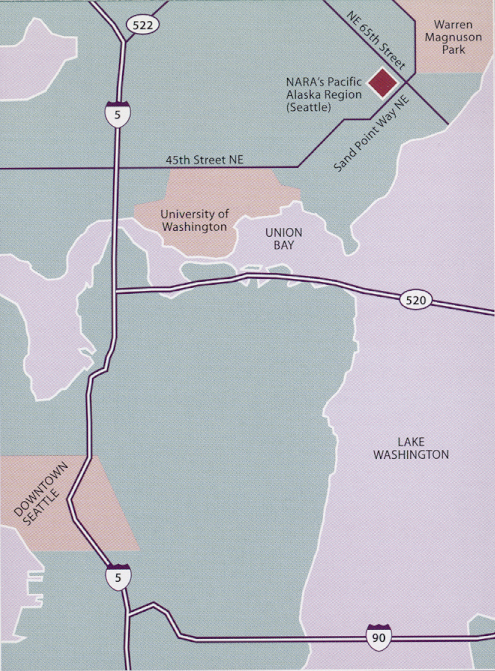
National Archives and Records Administration
6125 Sand Point Way NE
Seattle, WA 98115