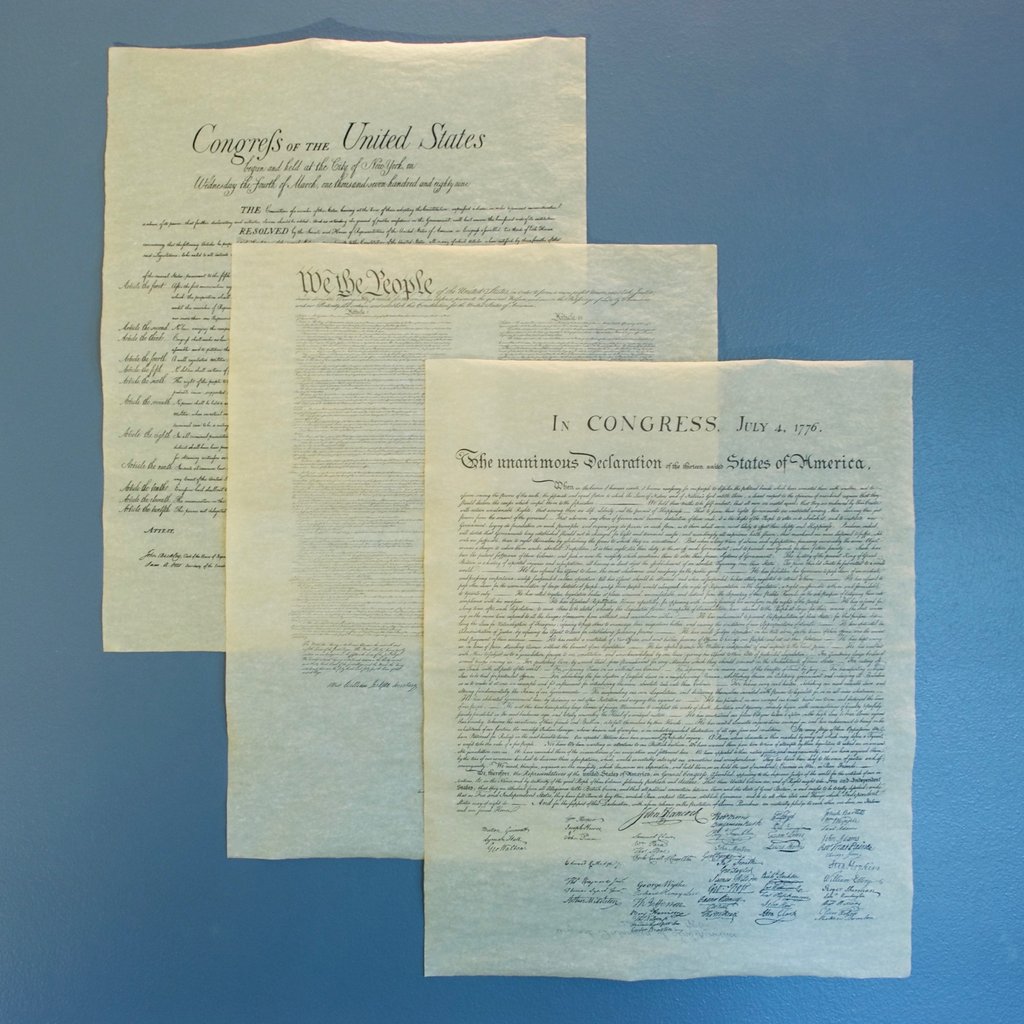
| Examining
the Documents
As a document was freed from its encasement, it became
available for close examination, measuring, and photography
without the barrier of intervening layers of glass.
While some records exist on the creation, history, travels,
and exhibition of the documents over the years—including
a few nineteenth- and twentieth-century photographs—the
information is relatively sparse. But the documents
themselves offered a wealth of clues and insights into
the ways they were created and handled. Patterns of
creases and folds on the documents pointed to how they
had been folded or stored.
The Bill of Rights still had pronounced horizontal
and vertical creases from having been folded, though
it had been stored flat for almost a century.
The Declaration had both fold lines and parallel horizontal
creases that were evidence of rolling. It also had a
noticeable band along all edges that was flat and very
clean. Records indicate that early in the twentieth
century the Declaration had been glued along the four
edges to a support.
The Constitution did not show evidence of folding but
had adhesive in broad strokes on the backs of the parchments,
suggesting that the leaves had been glued overall to
a backing.
Each document was available for direct examination
for a short time before re-encasement, but this time
was sufficient to apply modern examination techniques
and tools to evaluate and record the document's condition
and develop and carry out appropriate conservation treatment.
The full dimensions of each parchment were measured
as well as its average thickness, which varied somewhat
along the edges and from top to bottom. The color of
the parchment was measured. Many photographs were made
of the condition of the parchment before any treatment
was proposed or undertaken.
How the Charters
Were Made
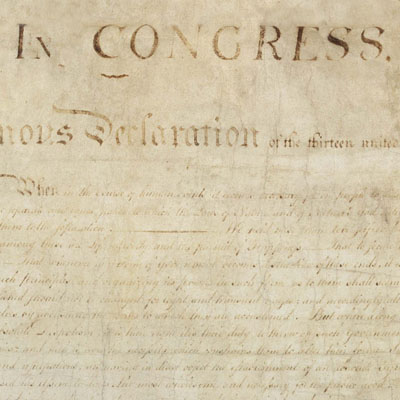
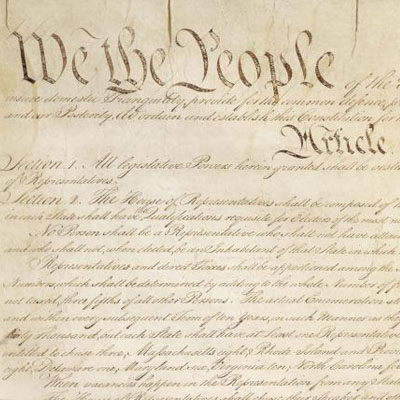
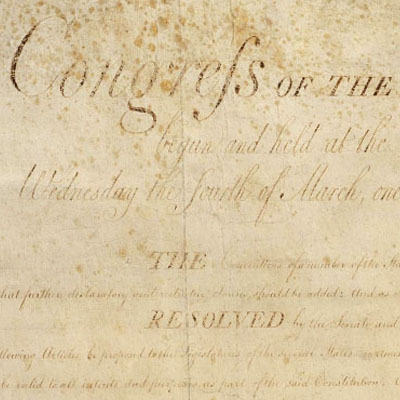
The Declaration of Independence, the Constitution,
and the Bill of Rights were handwritten by a clerk or
scribe on parchment, an animal skin specially treated
with lime and stretched to create a strong, long-lasting
writing support.
The clerk's job was a demanding one. He was trained
to create a fine handwritten text. In his work, he wrote
a very regular and legible cursive script, with titles
and important phrases engrossed, that is, made larger
and darker with additional strokes of ink. His tools
included a pen knife and quill pens cut from large feathers.
He wrote with ink made from oak galls and iron, with
gum arabic as binder, and often with a colorant such
as logwood added to enhance the initially pale ink.
Following English practice, he wrote important legal
documents and contracts on parchment. Parchment was
expensive, generally imported from Great Britain, but
its life expectancy was very long.
|
 |
 |
A conservator
examines the ink on Page One of the Constitution,
letter by letter. In the treatment of this document,
the most important step was to ensure that the original
iron gall ink remained well adhered. |
 |
 |
| |
 |
 |
|
| |
The image
at left shows loss in the edge of the parchment
near the word "America" on the Declaration
of Independence. At right is the same area after
conservation treatment. The loss was filled with
a small piece of Japanese paper that was toned and
burnished to resemble the parchment. With the loss
filled, the edge of the Declaration is stable and
visually intact. |
|
|
The clerk often had little time to take
a corrected rough draft and write out a "fair"
or "smooth" final legible copy before it was
to be signed. He needed rule lines to guide his hand
and ensure straight lines of text. Corrections were
difficult to make because parchment was such a tough
and unforgiving medium. He scraped out words or lines
with his penknife or inserted words or phrases carefully
into the text, sometimes including an errata paragraph
to attest that the approved document was unaltered.
The clerk could never have imagined that two centuries
later, conservators would peer through a binocular microscope
to examine his pen strokes. Examining these documents,
conservators found faint rule lines that were present
on several, appearing as reddish brown lines on the
Constitution and a gray medium on the Declaration. They
saw several scraped erasures on the documents, visible
as areas of roughened parchment often grayed with surface
dirt, and occasionally, omitted words or phrases inserted
into the text. On the last page of the Constitution,
the scribe wrote a final errata paragraph noting his
corrections to the text. Many random ink splotches or
spatter, large and small, show evidence of the difficulty
of writing with a quill pen.
Working closely with the documents, conservators also
came to recognize the characteristic handwriting of
the different scribes who wrote these three documents.
They also saw unobtrusive marks or annotations on the
documents, including small numbers, an "x"
mark, and brackets in the margins, presumably to mark
or emphasize a section of text. Who made these marks
and when is not known. Most of these faint marks appear
to be in a soft gray medium that resembles graphite.
|