
Italy’s WWII Helpers: The Helper Claims Transcription and Tagging Mission
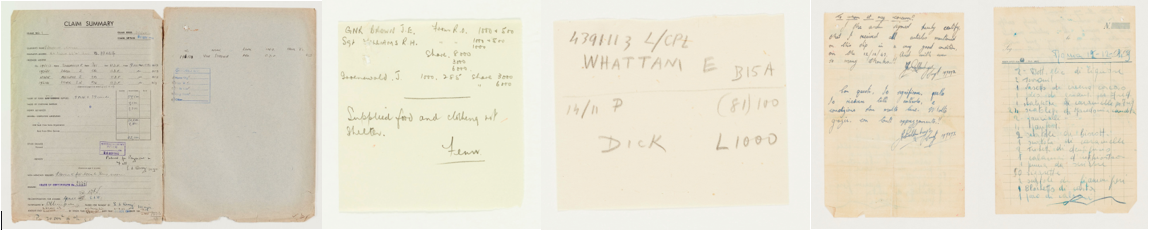
The Helper Claims files document the assistance provided by Italian civilians to Allied personnel after Italy's surrender in September 1943. Files contain personal artifacts left by the escapers themselves, such as chits and letters. The records include the names and addresses of the Italian civilians and the names of Allied personnel they assisted, including thousands of names, stories, and personal notes. The National Archives and Records Administration (NARA) and the Monte San Martino Trust have partnered to increase access to these records and invite the public to support the mission.
Get Involved in the Mission
Citizen archivists can play an essential role in making the handwritten and typewritten details searchable and discoverable through citizen transcription and tagging. Volunteers help transform these digitized documents into accessible data that researchers, educators, genealogists, and families can use to uncover the experiences of Italy’s wartime helpers.
Help transcribe and tag these records to unlock the details and stories found within these records.
Ready to Begin?
- New to the Citizen Archivist program? Learn how to register and get started.
- Be sure to review the video How to Transcribe in the National Archives Catalog, our tutorial Get Started Transcribing and how-to videos on the Resources page.
- Check out the tagging tips for What Makes A Good Tag?
- Already have an account? Login here.
- Select a Helper Claims File in the National Archives Catalog and begin transcribing or tagging.
- Questions? Check out our Frequently Asked Questions below or email citizenarchivist@nara.gov.
About the Partnership
The National Archives and Records Administration (NARA), in partnership with the Monte San Martino Trust, is digitizing and sharing records of the Allied Screening Commission (Italy) and its successor, the Prisoner-of-War Claims Commission (AFHQ). These records document thousands of claims submitted by Italians who provided shelter, food, clothing, or guidance to Allied prisoners of war and evaders between 1943 and 1947.
The Monte San Martino Trust is a UK-based registered charity founded in 1989 by J. Keith Killby, a former prisoner of war in Italy, together with other veterans of the Second World War. The Trust is funded entirely by donations and staffed by volunteers, continuing Killby's mission to honor Italian civilian helpers long after his passing.
This partnership combines the Trust's knowledge of escape narratives and Italian helper networks with the National Archives' professional digitization capabilities and public access infrastructure, ensuring these stories are accessible online worldwide while maintaining archival standards.
Frequently Asked Questions
I'm new; how do I get started?
You will need to have an account in the National Archives Catalog to contribute transcriptions, tags, and comments. Visit our Register and Get Started page for step-by-step instructions. We suggest you watch How to Transcribe in the National Archives Catalog and check out our Resources page for instructions to help you with your work as a Citizen Archivist. Here is a list of Helper Claims Files.
What do I do when I can't read a page?
Some digitized pages are low contrast or the original page was damaged and may be difficult to transcribe. You are welcome to skip any page that you are unable to transcribe.
So many pages have already been transcribed, how do I find a page that needs to be transcribed?
We always have thousands of pages available for transcription, but it may take some looking to find them. If you are still struggling to find a record with pages to transcribe in a Citizen Archivist mission, skip to the middle or the end of a list of records in a mission; often they have not yet been transcribed or tagged. Be sure to review the step by step instructions How to find a page to transcribe found in Get Started Transcribing if you need more help.
Can I add tags to these records?
Yes. Our first priority is transcription, but you may also add tags. Please review What Makes a Good Tag in order to add meaningful and helpful tags to these records.
Should I log out of my Catalog account when I'm done?
Yes. Be sure to log out each day. Users need to log in and log out of their Catalog accounts each day so if our developers make any code changes to the Catalog overnight, your account and Citizen Archivist experience will work properly.
What are “Italian Helpers”?
Italian civilians, who became known as "Italian Helpers," provided assistance to the nearly 80,000 Allied Prisoners of War (POWs) who escaped from Italian camps after the September 8, 1943 armistice. They provided the Allied POWs with food, water, clothing, shelter, and financial assistance to escapees so they could continue their journey to Allied-control territories. Some “Italian Helpers” served as guides, couriers, and coordinators for Allied networks, enabling escapees to reach safety in Allied-controlled territories. Some helped forge identity papers and provided civilian clothes to help POWs blend in with the local population.
What are the claims files?
The series Helper Claims (Italy), July 1944 - April 1947 (NAID 52088435) consists of claim files for those in Italy who helped Allied escapers and evaders, after September 8, 1943. Each claim ordinarily consists of from five to ten documents, including a claim summary, a receipt for monetary reimbursement (Office Form 11 [O.F. 11]), a claims progress report (Office Form 4 [O.F. 4]), the original claim, and miscellaneous forms and notes prepared by agents investigating the claim, and the recommendation made by the investigating officer. In many, if not most cases, the file contains documents left with the helpers by the escapers and evaders, such as chits and letters, so they could present them to the competent Allied authority and be compensated for the help given. They are arranged numerically by claim file number, 1-83424 and 100001-104603.
How many pages of the Italian Helper Claims files are online?
Thanks in part to the donation from Monte San Martino Trust, NARA has digitized more than 18,000 pages of the files that are available online in the Catalog and awaiting transcription. Additional boxes will be digitized and added to the Catalog on a rolling basis and added to this transcription and tagging mission.
Are there more related records from the National Archives?
Here is an alphabetical list of some related records.
Related Records
- Administrative Subject File
- Alphabetical Register of Claimants
- Approved Death Claims
- Assistance Given Them
- Austrian Claimant Correspondence
- Cash Book
- Claim Lists
- Claim Subject File
- Correspondence of the American Representative
- Correspondence of the Rome Organization
- Correspondence Regarding Claims and Administrative Matters
- Correspondence Relating to Claimants
- Daily Bulletins
- “D” Lists and Additional Payment Forms
- “D” Lists and Related Correspondence
- "D" Lists of Payments
- Disbandment of the Prisoner of War Claims Screening Commission File
- General Claims Correspondence
- Helper Claims
- Identity Cards for American Prisoners of Italian Army
- Identity Cards for French Prisoners of Italian Army
- Identity Cards for Greek Prisoners of Italian Army
- Index of American Escapers and Evaders
- Index to Helper Claims Processed after the Closing of the Allied Screening Commission (Italy)
- Index to Helper Claims, 1946-1947
- Index to Helper Claims, July 1944-1946
- Interrogations of and Statements Made by American Escapers and Evaders Regarding Register of Death Claims Approved and Paid and Rejected Death Claims
- Inventory of the Records of the Prisoner of War Claims Screening Commission and the Allied Screening Commission (Italy)
- Lists of American Escapers and Evaders
- Lists of Austrian Claims and Certificates
- Lists of Cancelled Claims
- Lists of Claims Paid in the Rome Office
- Lists of Italian Helper Claims Registered after February 28, 1946
- Loss of Life Register
- Maps, Charts, Registers, and Photographs
- Monthly Reports
- Movement Orders Register
- Operation Memorandums
- Orders
- Payment Lists and Related Records Pertaining to Austrian Helpers
- Recommendations for Award of Bronze Star Medal
- Records Relating to an Appreciation (Understanding) of the Allied Screening Commission (Italy)
- Reference Set of Basic Documents
- Register Book of American Escapers and Evaders
- Register of Deceased Claimants
- Specimen Form Letters
- Subject File Maintained by Lieutenant Colonel Hugo Graham De Burgh
- Thank You Letters Acknowledging Receipt of Certificates and Payments
- War Diaries
- War Establishment File
Additional questions? Email citizenarchivist@nara.gov