
High School Distance Learning Programs
Visit the National Archives without leaving your classroom!
Beginning with the 2026-2027 school year, our distance learning programs will merge with our Civics for All of Us offerings to create a unified virtual programming experience and enhance access to the National Archives’ learning experiences and resources.
Reservations for the upcoming school year will open in August 2026. Please visit civics.archives.gov at that time for more information about program offerings.
For questions and to request your program, email civics@nara.gov.
ASL interpreters are available with at least 14 business days' advance notice.
General Education
The Founding Documents: Building a More Perfect Union
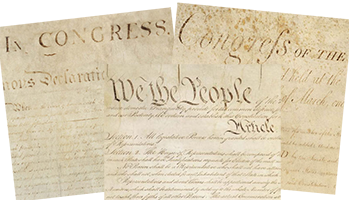
Students will analyze opening passages of the Declaration of Independence, the Constitution, and the Bill of Rights. They will create a graphic organizer to help them distinguish the founding documents by their purpose. Next, students will match document excerpts to each excerpt’s origin – the Declaration of Independence, the Constitution, or the Bill of Rights. The program will conclude with a discussion about the legacy of these founding documents.
- For grades 6-12
- 45 minutes
Rightfully Hers: American Women and the Vote

Using the founding documents of the United States and records of the National Archives, students will determine how and why women fought for the right to vote. Students will explore the challenges suffragists faced and discover why the fight for women’s voting rights persisted even after the ratification of the 19th Amendment.
- For grades 9-12
- 45 minutes
The Declaration of Independence
We Hold These Truths
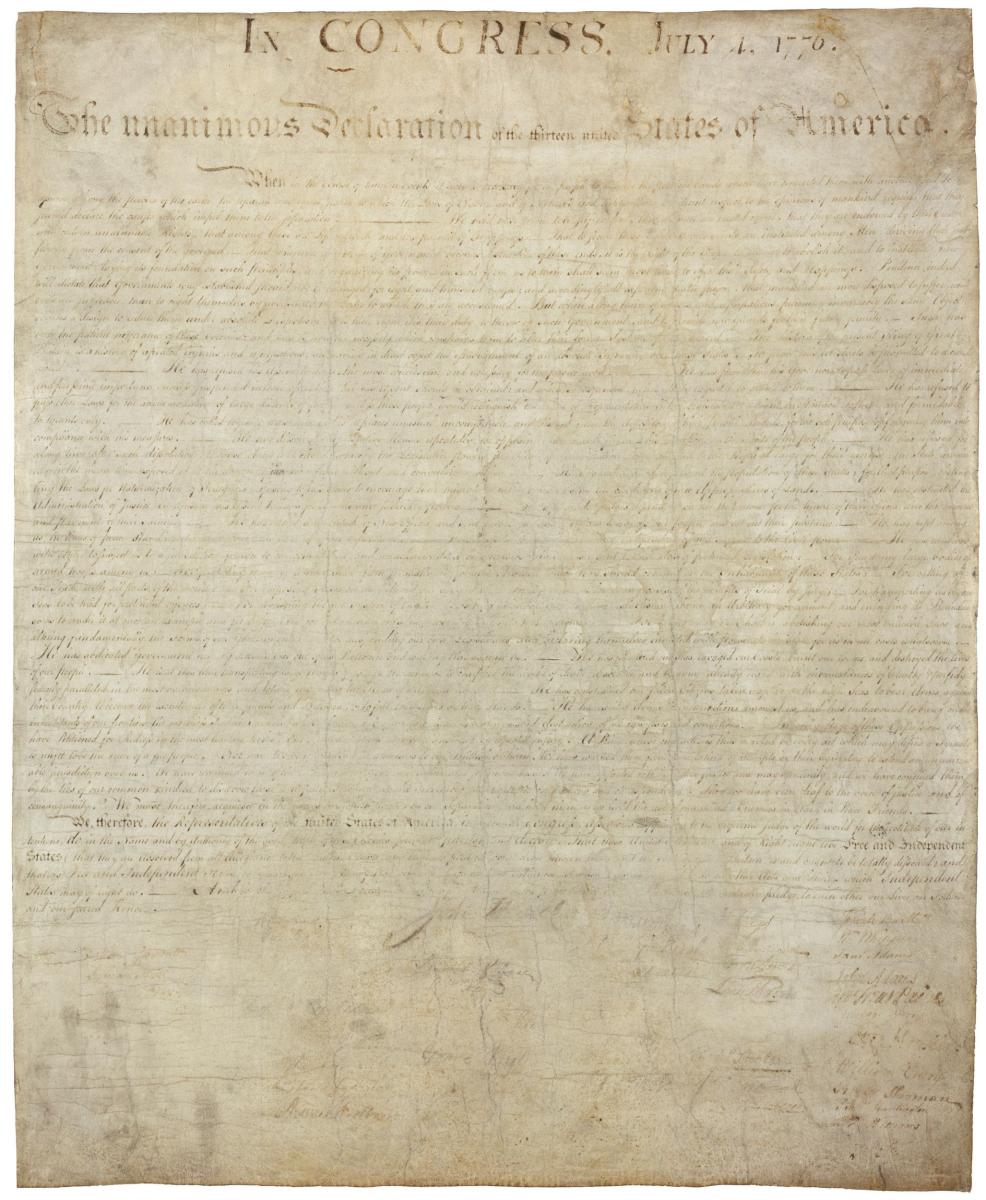
Students will explore the Declaration of Independence as an artifact, a primary source, and a persuasive text. Students explore the document's important sections, and evaluate the persuasive elements of the Declaration of Independence.
- For grades 9-12
- 45 minutes
This program is offered as a part of Civics for All of US, an education initiative from the National Archives that promotes civic literacy and engagement.
The United States Constitution
No Conscription Without Representation: Voting Rights and the Constitution

Using the Constitution, constitutional amendments, legislation, and a Supreme Court case, students will explore the progression of voting rights in the United States with particular focus on the effort to lower the voting age to 18. Additional primary source documents from the National Archives, including photographs, video recordings, and political cartoons, will enhance student understanding of the ways in which contemporary events and public civic engagement influence their lives today.
- For grades 9-12
- 40 minutes
This program is offered as a part of Civics for All of US, an education initiative from the National Archives that promotes civic literacy and engagement.
The Bill of Rights
The Bill of Rights Protects You
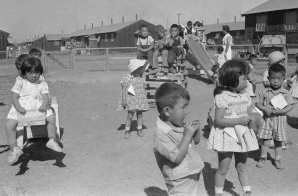
In this program, students will explore the Bill of Rights and how it outlines both limits on government and the rights of the people. We will work together to analyze three case studies that underscore the remedies that citizens can use to address instances where their rights have been violated. This program will introduce students to the Bill of Rights and strengthen their civic understanding.
- For grades 9-12
- 40 minutes
This program is offered as a part of Civics for All of US, an education initiative from the National Archives that promotes civic literacy and engagement.