
House Accompanying Papers
Did you know that a significant proportion of the records of Congress during the 19th century consist of private claims submitted directly to the U.S. House of Representatives and the U.S. Senate from individuals and groups? Most of these claims came from common citizens seeking pensions or payment of claims against the Government.
Private claims and other forms of private relief submitted to the House of Representatives from the 39th through the 57th Congresses (1865-1903) form the series House Accompanying Papers, which is part of Record Group 233 at the Center for Legislative Archives. These records are a rich source of information for genealogists and local historians.
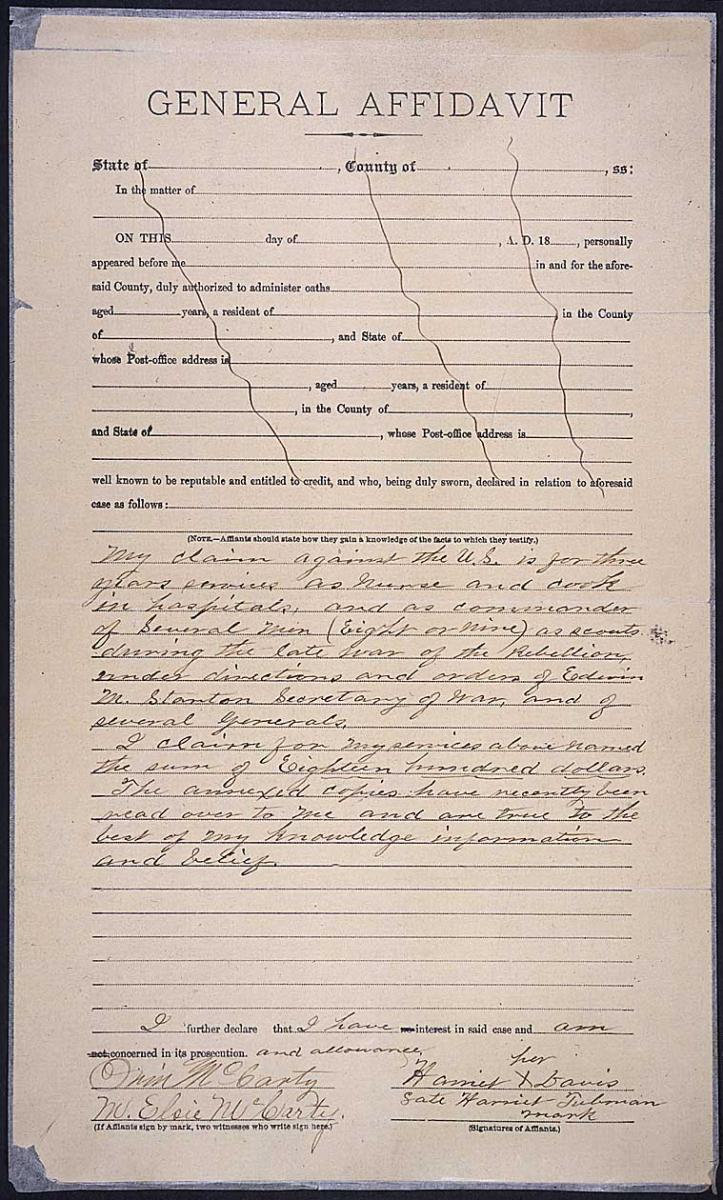
General affidavit of Harriet Tubman relating to her claim for a pension, ca. 1898. Accompanying Papers of the 55th Congress, RG 233, Records of the U.S. House of Representatives, National Archives.
Although many claims are for pensions, such as that of Andrew W. Jones, a private in the Oregon Volunteers, who requested a pension in the 52nd Congress (1891-1893) for his service in the Rogue River Indian War of 1855-1856 where he suffered a gunshot wound to the back of his neck, others concern a host of topics.
During the 46th Congress (1879-1881), for example, the claims include that of:
- Susan B. Anthony, seeking relief from political disabilities and requesting woman suffrage as a right of citizenship,
- the petition of the shareholders of the Central and South American Cable Company for a telegraph line connecting those areas with the U.S., and
- the memorial of the members of the Prairie Grove Presbyterian Church in Arkansas for compensation after their church was torn down for wood to make coffins for the soldiers who fell during the Civil War battle of Prairie Grove in 1862.
The records consist of petitions, bills, resolutions, correspondence, committee reports, affidavits, and other supporting documentation of the claims. Some claim files even contain maps, photographs, letters patent, muster rolls, news clippings, and marriage certificates.
The House Accompanying Papers files were bill files, mostly concerning private legislation, that were collected together from the various committees, and arranged in a single alphabetical sequence for each Congress. This series is the primary location of records relating to private legislation between the 39th and 57th Congresses. Before this period, private claims are found in the committee papers or the petitions and memorials series of the appropriate committee. After this period, they are found in committee bill files.
The records are arranged by Congress and then alphabetically by person, organization, state, territory, or subject.
For many of the Congresses, particularly the early ones, the Center for Legislative Archives holds folder title lists of the claims. Claims may also be located using the House Journal and the Congressional Record—but be aware that not all claims referenced in those publications are still extant in the records. In order for the Center's archivists to locate the original records, researchers need to know the name of the claimant and the Congress(es) in which the claim was submitted to the House.
For more information on the House Accompanying Paper series, we recommend the following resources:
- "A Final Appeal to Capitol Hill: The U.S. House's Accompanying Papers File, 1865–1903", a 2007 article from Prologue Magazine by archivist John Deeben
- The Accompanying Papers Files of the U.S. House of Representatives, 1865-1877
- Section 24.20 of Chapter 24 of the Guide to Records of the U.S. House of Representatives
- Know Your Records presentation on House Accompanying Papers on NARA's YouTube channel
For assistance, please email us at legislative.archives@nara.gov.