
How to Use the Congressional Record
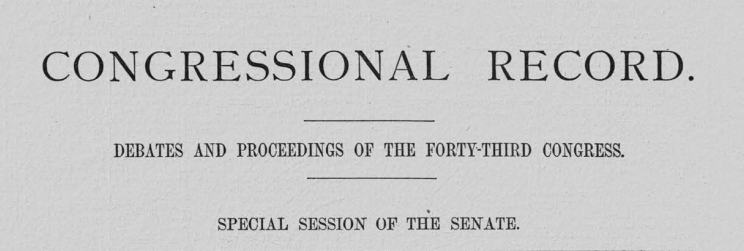
The Congressional Record is the record of proceedings and debates on the floor of the U.S. House of Representatives and the U.S. Senate. It's published daily when one or both chambers of Congress are in session, and a permanent, bound edition is published after the end of each session of Congress.
The Congressional Record first began publication in 1873, but it is preceded by three other publications: the Annals of Congress (1789-1824), the Register of Debates (1824-1837), and the Congressional Globe (1833-1873).
While later volumes of the Congressional Globe began to provide something approaching verbatim coverage, most of these early publications only have paraphrased speeches, condensed reports, and summaries. For more background on these early publications, the Law Librarians' Society of Washington, DC has put together a helpful Overview of the Congressional Record and Its Predecessor Publications.
The Congressional Record is freely available online via Congress.gov—the official website for U.S. federal legislative information, developed and maintained by the Library of Congress. Congress.gov has the daily Congressional Record issues dating from 1995, and then the bound edition from 1873 through 1994. You can also access the Congressional Record via subscription databases like HeinOnline, which may be available through a local library, and also through GovInfo.
This guide walks through several example searches:
- How to Conduct a General Keyword Search
- How to Find Information on a Member of Congress
- How to Find Information on Legislation
How to Conduct a General Keyword Search
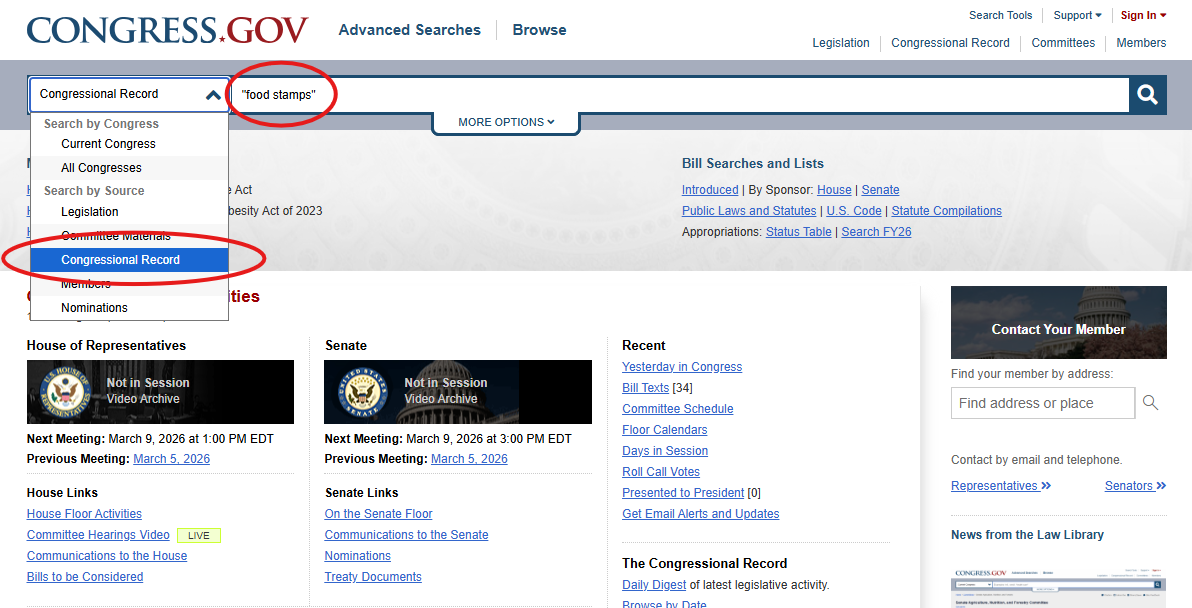
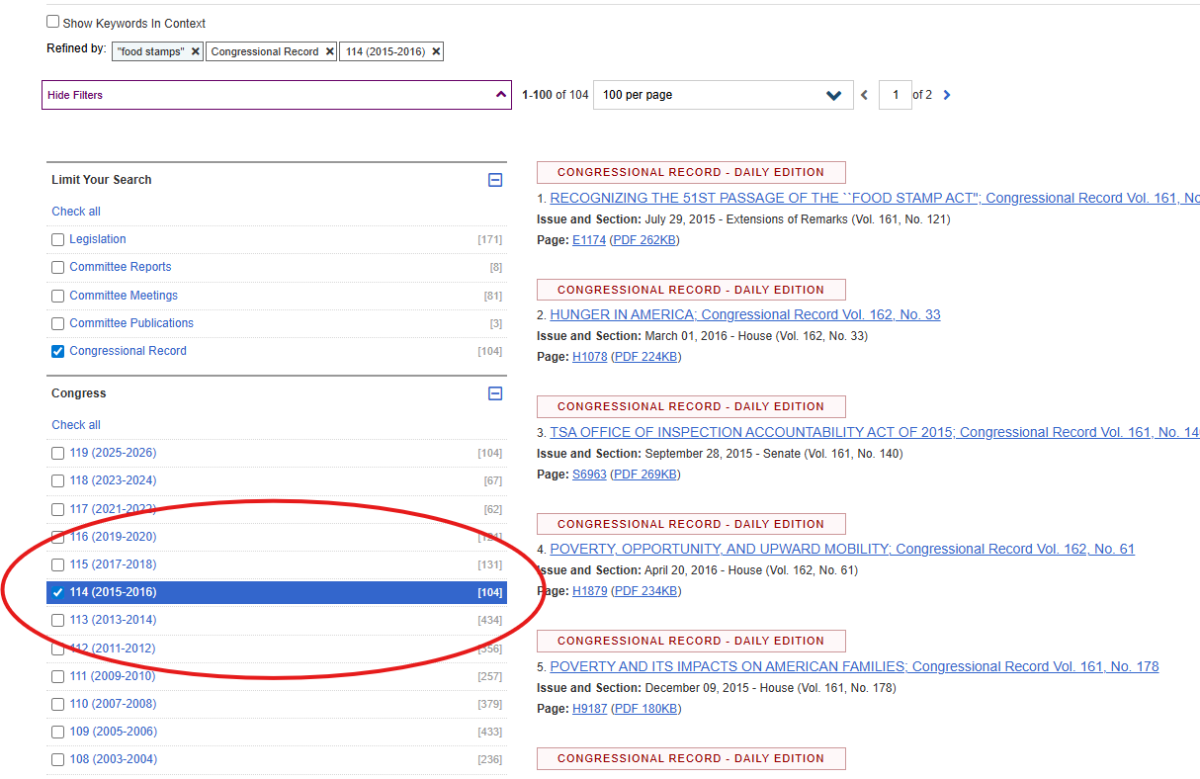
You can conduct a general keyword search using the main search bar on the Congress.gov homepage. Enter a keyword and limit your search fields to the Congressional Record using the dropdown menu. Then, you can narrow your search results to a specific Congress or range of Congresses.
For a more comprehensive search, there are two main access points for using the Congressional Record: the Index to the Proceedings and the History of Bills and Resolutions, which are always included at the end of each bound edition volume. Below are two scenarios that walk you through how to use the Congressional Record using these two access points. The first scenario is how to find information on a specific Member of Congress, and the second scenario is how to find information on specific legislation.
How to Find Information on a Member of Congress
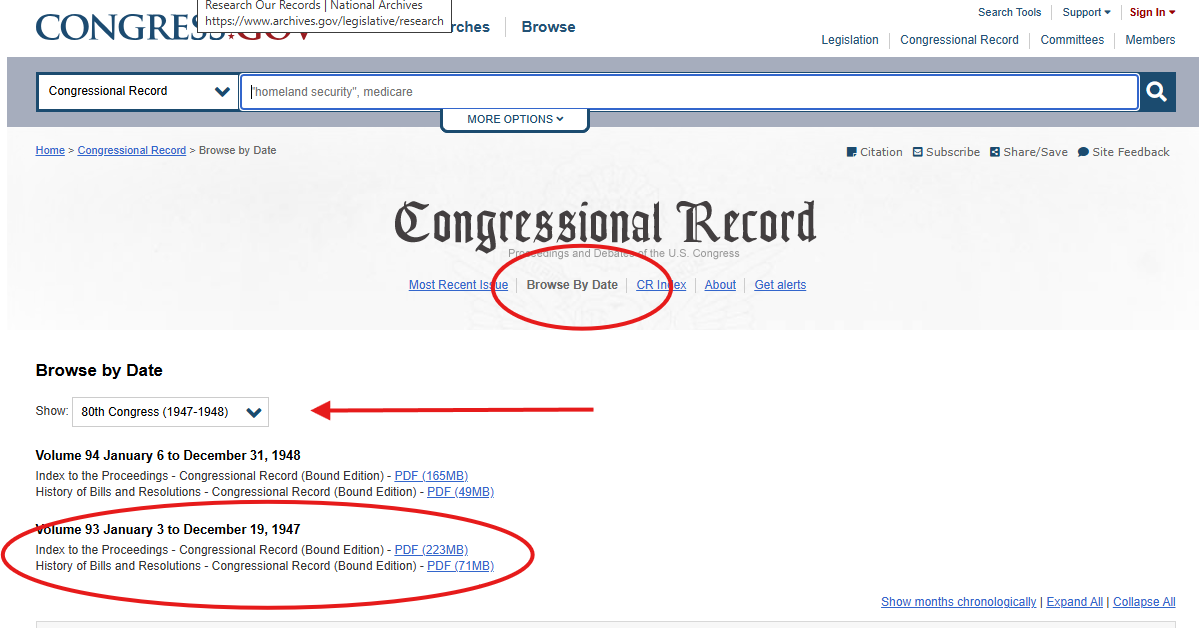
For our first example, let's say you're looking for a 1947 speech given by Rep. John Davis Lodge—a Representative who served in the House in the 80th and 81st Congresses. To search for a specific floor speech, start with the “Browse by Date” search feature on Congress.gov and use the dropdown to find the index for 1947.
Open the PDF and scroll down until you see the 'L's and then look for 'Lodge, John Davis' (the entry starts on page 335). Under his name is a list of all the content in the Congressional Record related to Representative Lodge in that session of Congress—here, it's the first session of the 80th Congress.
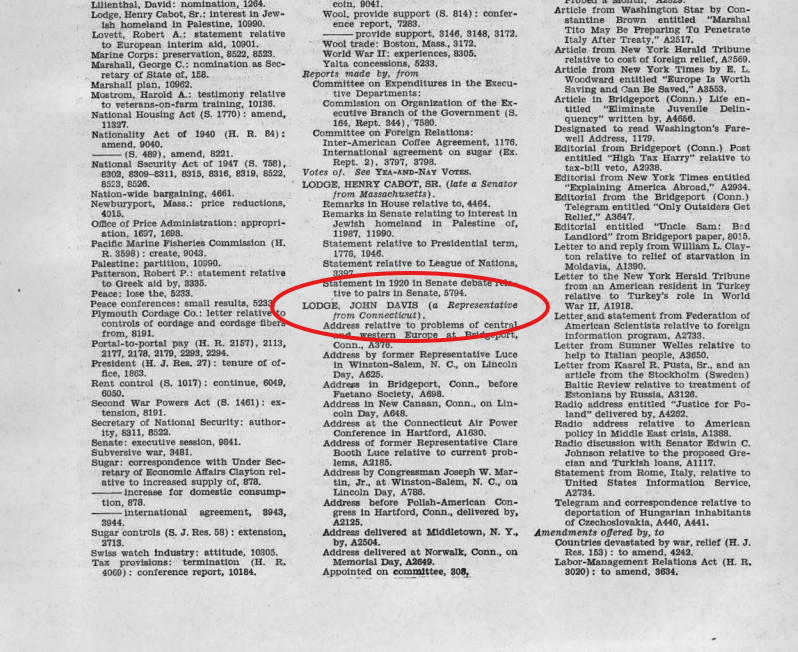
Screenshot of index page showing the entry for "Lodge, John Davis" in the Congressional Record from the 80th Congress, 1st Session.
Under the heading 'Remarks by, on' on page 336 is a list of all the speeches Representative Lodge made on the floor of the House in that session. He made remarks on several topics, but let's say you're interested in the speech noted as 'American people: generosity, 11096'. The '11096' number is the page number in this Volume on which these remarks begin.
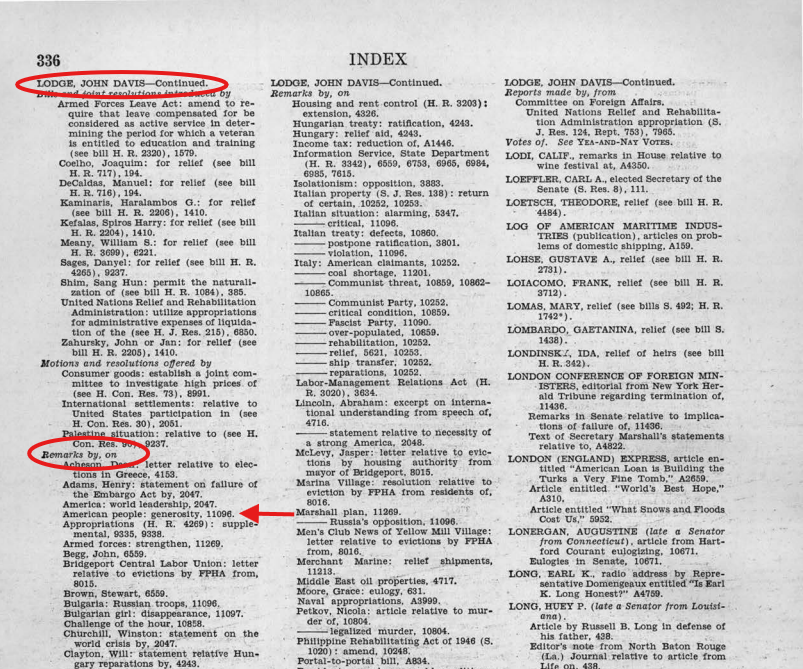
Screenshot of index page showing the entry for Remarks by John Davis Lodge in the Congressional Record from the 80th Congress, 1st Session.
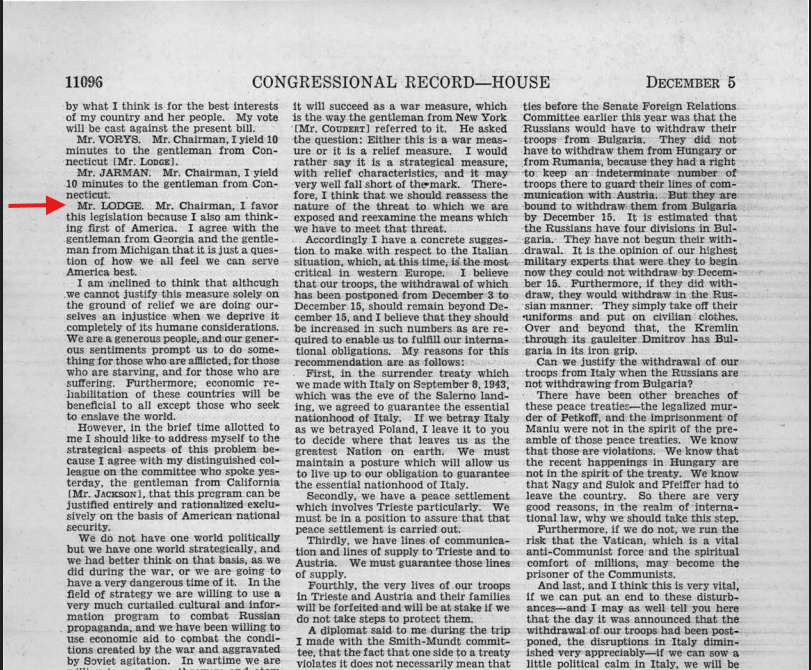
Go back to the landing page for the Congressional Record from 1947 and find the page section that include page 11096.
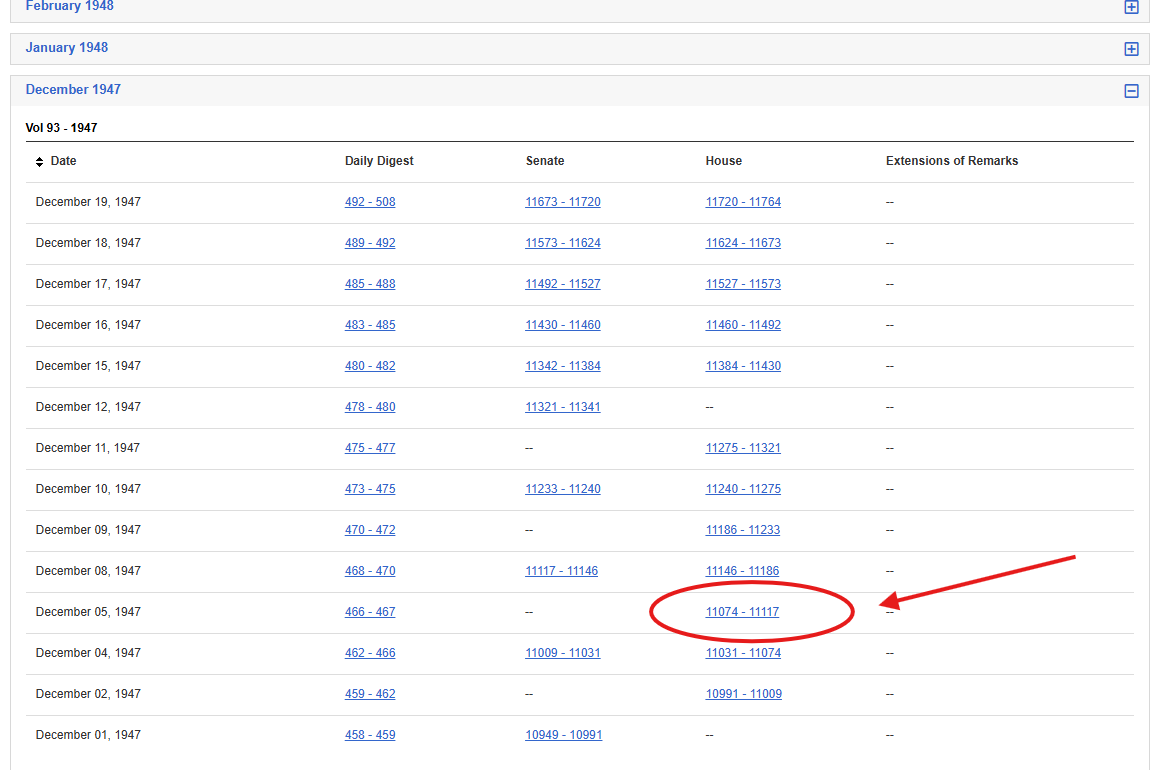
Screenshot of downloadable page sections of the Congressional Record from the 80th Congress, 1st Session on Congress.gov.
Back to Top
How to Find Information on Legislation
For our second example, let's say you want to dig into the legislative history of the Fair Labor Standards Act of 1938.
Use the “Browse by Date” search function on Congress.gov and use the dropdown menu to find the Congressional Record from 1938.
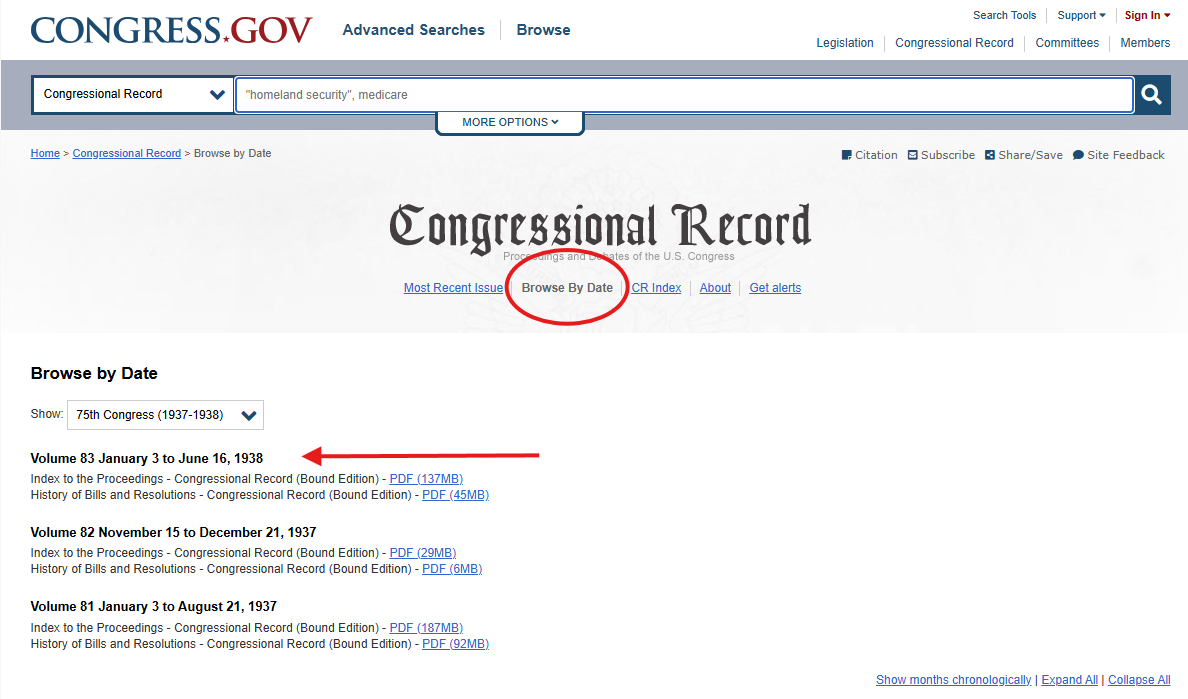
Screenshot of "Browse by Date" page on Congress.gov showing Congressional Record volumes from 1937 and 1938.
Open the Index to Proceedings from 1938. Scroll through the PDF until you hit the 'F's and then look for an entry on fair labor. On page 143 is an entry on 'Fair Labor Standards in Employments,' under which is 'Bills to provide for the establishment of (see bills S. 2475*, 4175*; H.R. 10492, 10538, 10671).' These are all the bills introduced in the 75th Congress on establishing fair labor standards. Bills with asterisks passed the chamber, whereas bills without asterisks may be related bills or bills that did not pass.
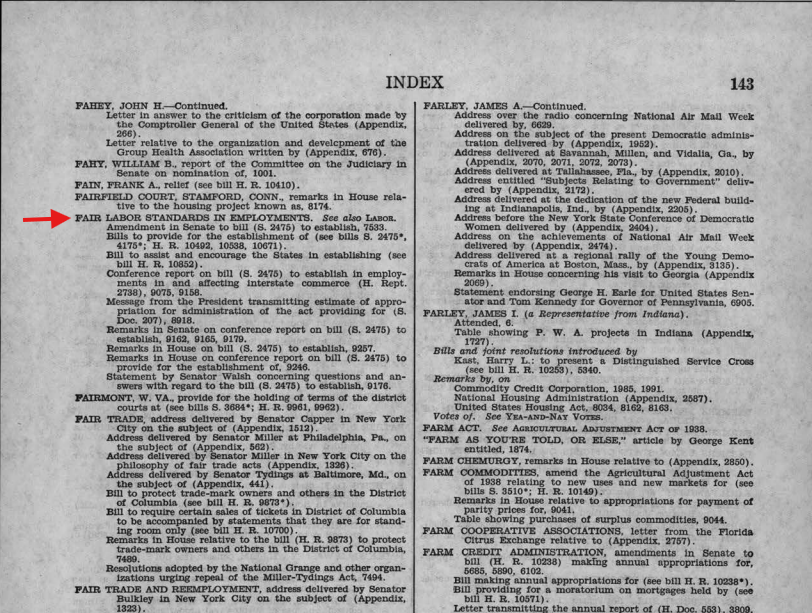
Screenshot of entry for "Fair Labor Standards in Employments" in the index to the Congressional Record from the 75th Congress, 3rd Session.
Knowing these bill numbers, go back to the landing page for the Congressional Record and open History of Bills and Resolutions from 1938.
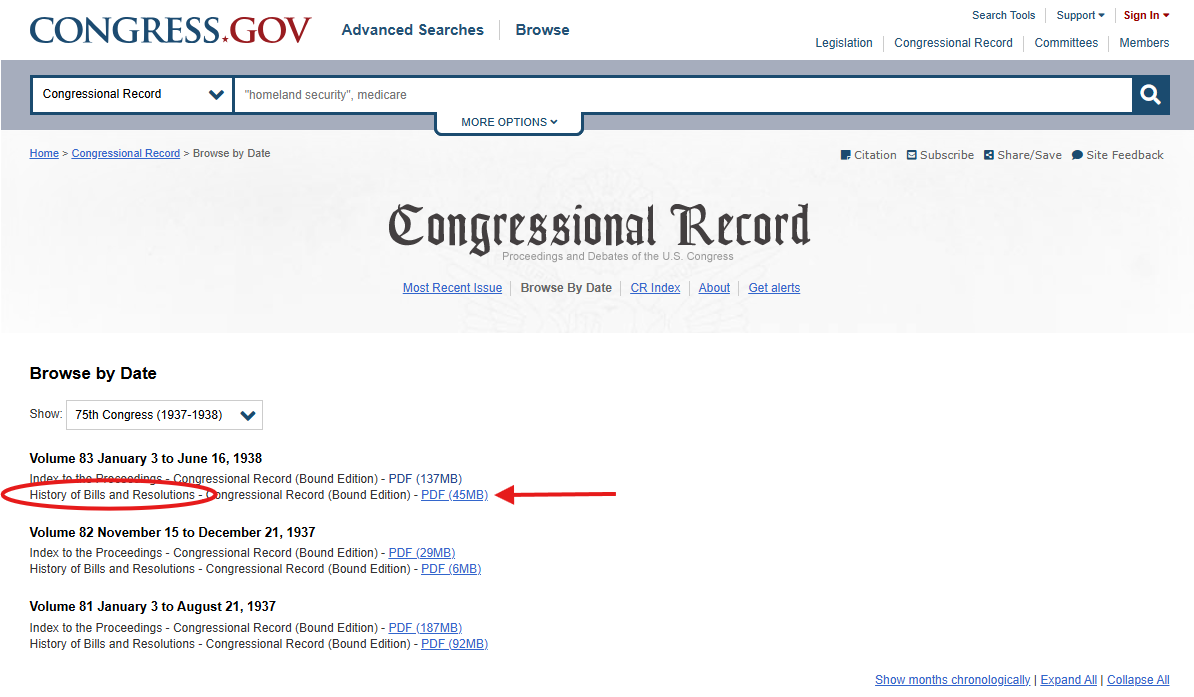
Screenshot of "Browse by Date" page on Congress.gov showing Congressional Record volumes from 1937 and 1938.
The History of Bills and Resolutions opens with Senate bills -- start by looking up S. 2475. It's on page 416. This entry has the full title of the bill, the numbers of any published reports, and the pages on which there was floor debate on the bill. The entry also tells us the Public Law number -- PL 75-718 -- which means this is the bill that passed into a law establishing fair labor standards. The text of Public Law 75-718 can be found in the Statutes at Large, which is freely available online through the Library of Congress (1st to 81st Congresses) and GovInfo (82nd to 113th Congresses).
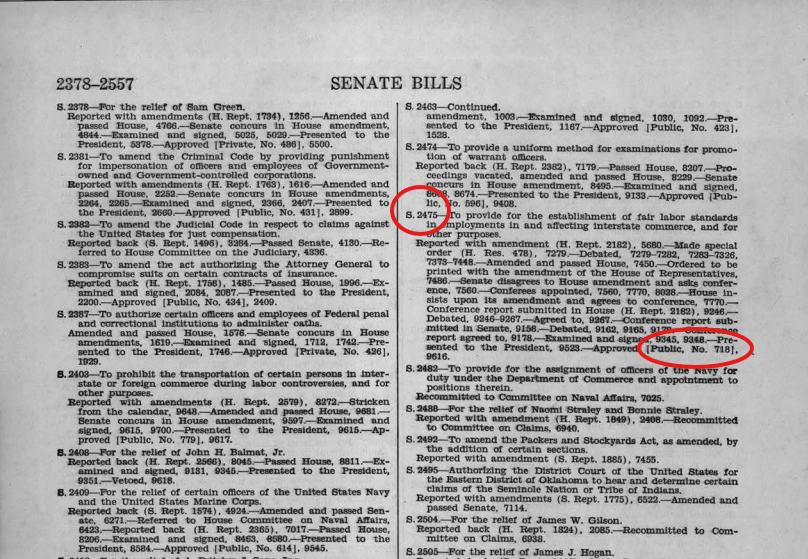
Screenshot of entry for S. 2475 in the History of Bills and Resolutions from the 75th Congress, 3rd Session.
What this entry does not tell us is when the bill was introduced or to which committee(s) the bill was referred, which means it was introduced in an earlier session in the 75th Congress.
Before we trace S. 2475 through earlier sessions of the 75th Congress though, we can keep looking through the History of Bills and Resolutions for the other bill numbers we have: S. 4175, H.R. 10492, H.R. 10538, and H.R. 10671.
The entries for these four bills let us know that they were introduced and referred to the Senate Committee on Education and Labor and the House Committee on Labor, but there were no committee reports issued or floor debate on any of these bills—they died in committee. Here's the entry for H.R. 10492 as an example.
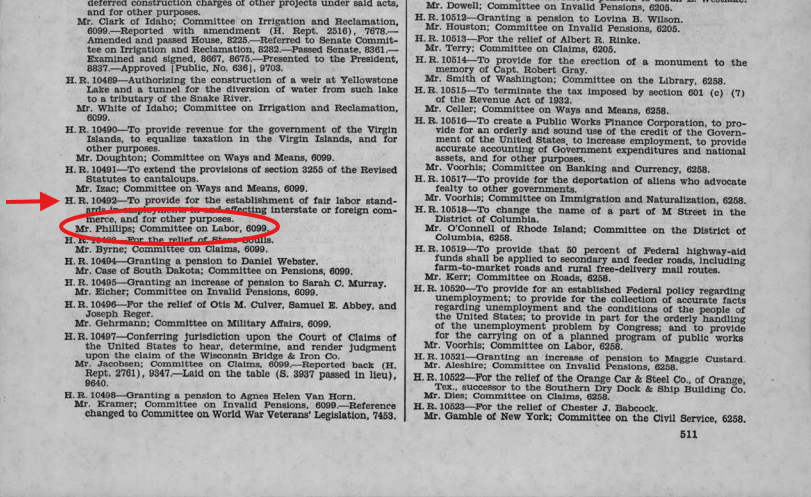
Screenshot of entry for H.R. 10492 in the History of Bills and Resolutions of the Congressional Record from the 75th Congress, 3rd Session.
Back to S. 2475, to trace this bill through earlier sessions, start by going back to the landing page for the Congressional Record and look for the volume in the previous session of the 75th Congress. On the landing page there are two Volumes for 1937, which means there were three sessions total in the 75th Congress. To check on the dates of a session of Congress, the Senate website has a reference list.
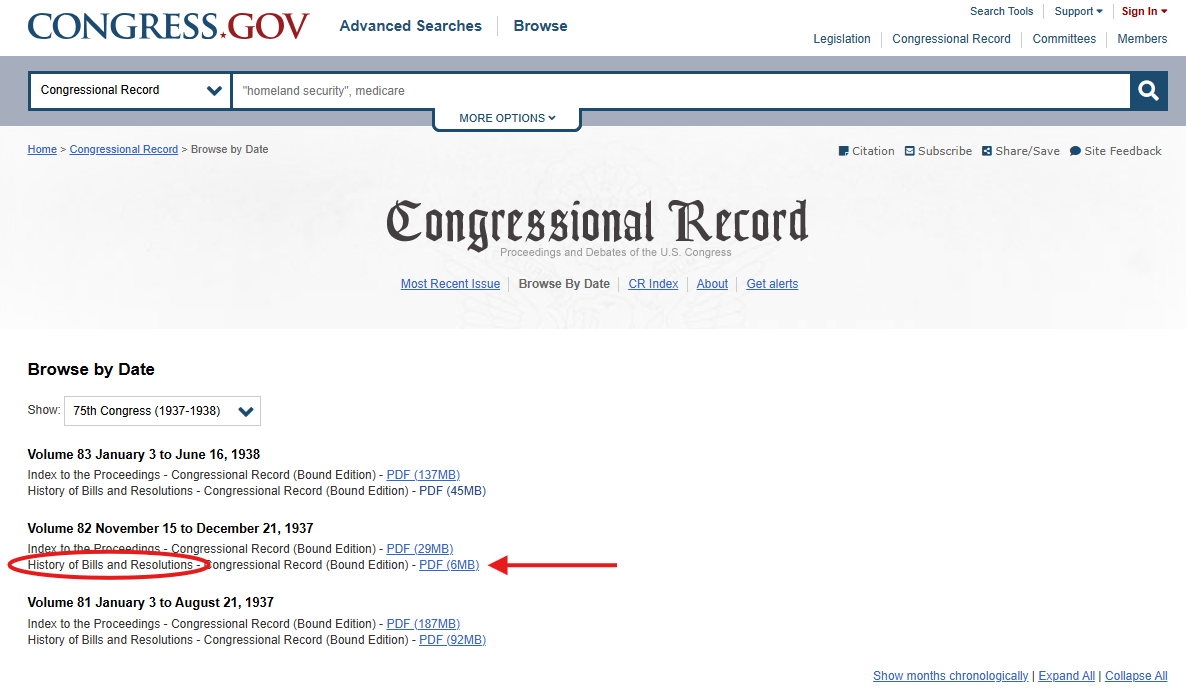
Screenshot of "Browse by Date" page on Congress.gov showing Congressional Record volumes from 1937 and 1938.
Open History of Bills and Resolutions for 1937, 2nd Session, and look up S. 2475. The entry for S. 2475 shows that action was taken on the bill in the second session as there are many pages of floor debate listed. However, the bill was not introduced here, so it must have been in the first session.
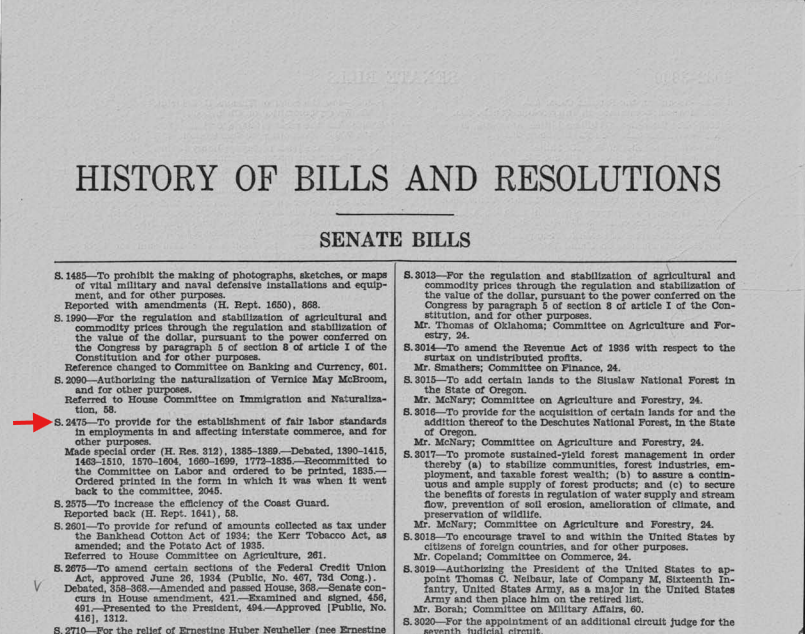
Screenshot of entry for S.2475 in the History of Bills and Resolutions of the Congressional Record from the 75th Congress, 2nd Session.
Go back once more to the landing page for the Congressional Record and open History of Bills and Resolutions for the 1st Session.
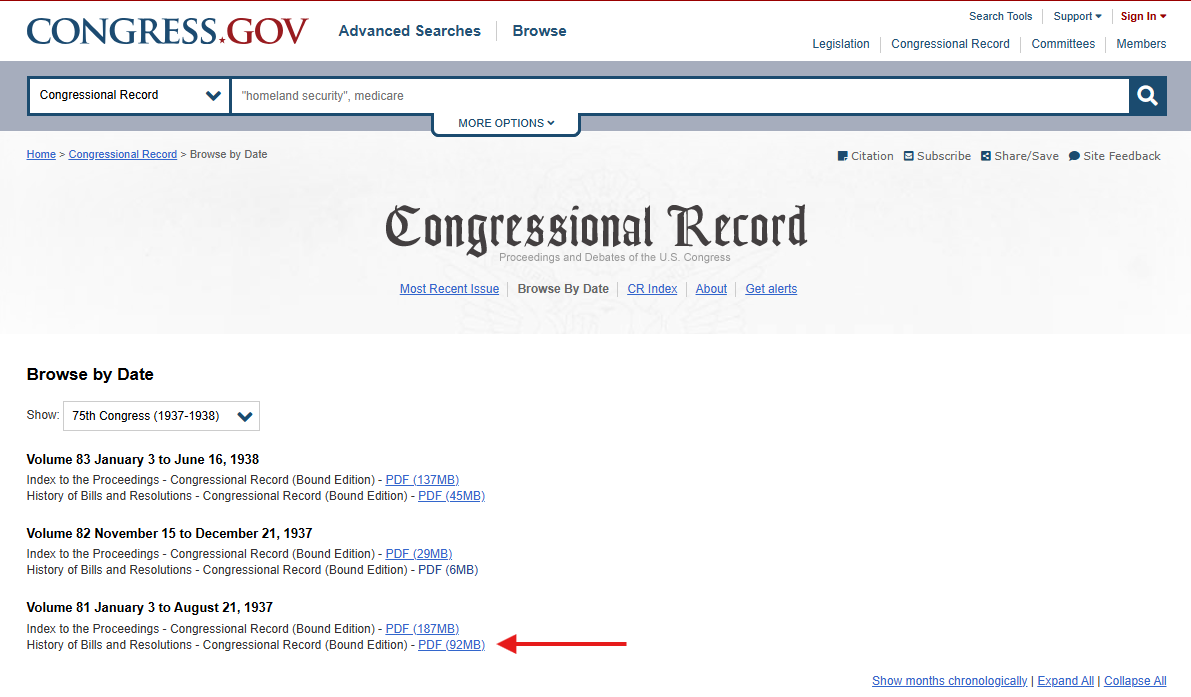
Screenshot of "Browse by Date" page on Congress.gov showing Congressional Record volumes from 1937 and 1938.
The entry for S. 2475 (starting on page 665) gives the full title of the bill, has information on which committee(s) it was referred to—the Senate Committee on Education and Labor and the House Committee on Labor—the pages on which the bill was debated on the floor, and the numbers of the published committee reports: S.Rpt.75-884 and H.Rpt.75-1452.
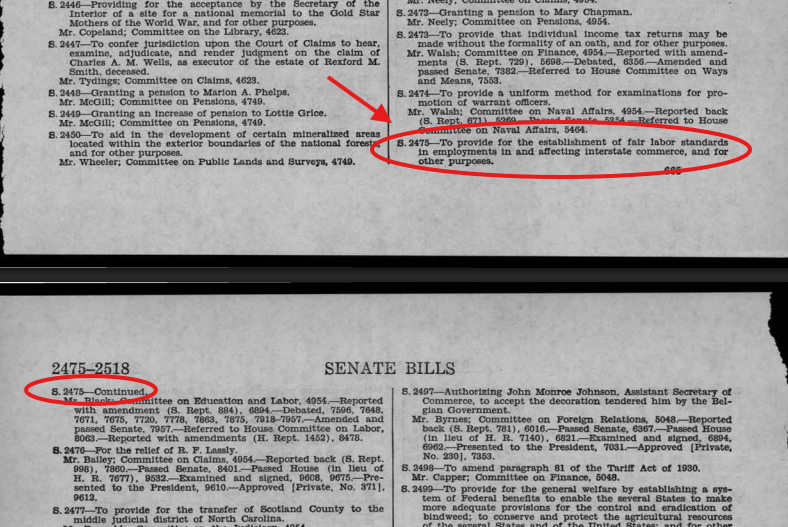
Screenshot of entry for S. 2475 from the History of Bills and Resolutions of the Congressional Record from the 75th Congress, 1st Session.
The first page number for floor debate here is 7596. Go back to the landing page and find the page sections that include page 7596.
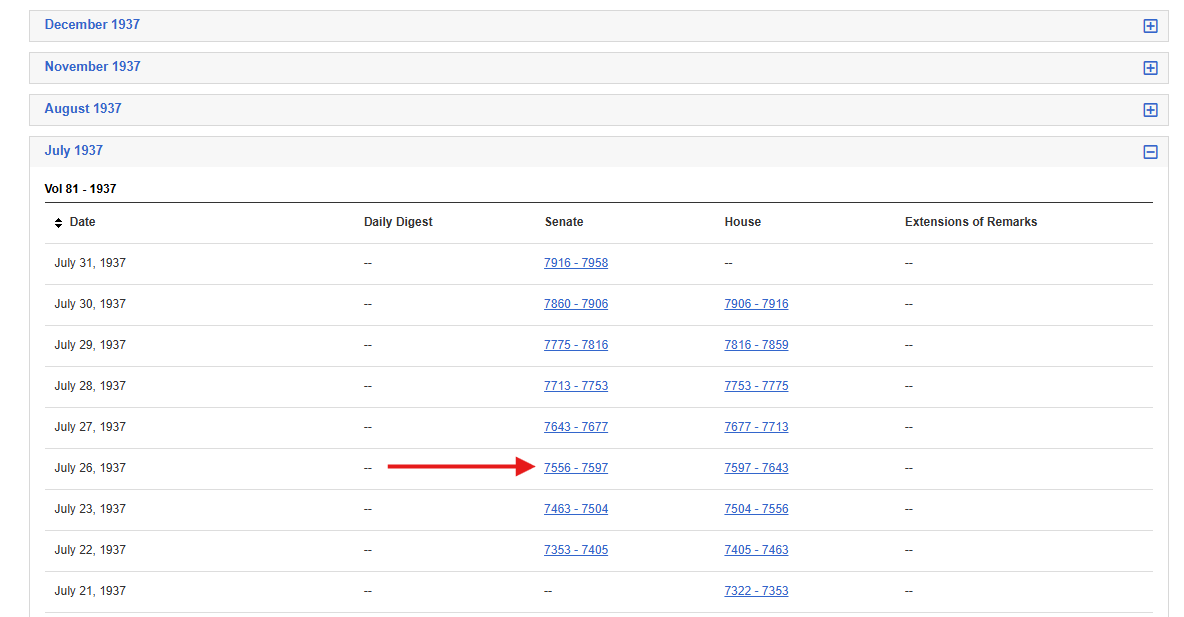
Screenshot of downloadable page sections of the Congressional Record from the 75th Congress, 1st Session on Congress.gov.
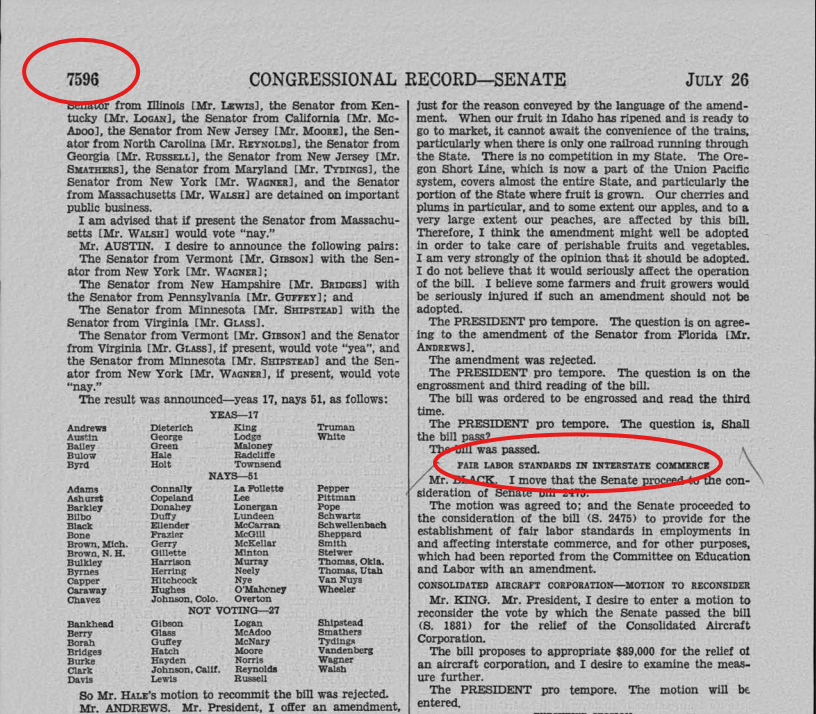
Screenshot of page 7596 of the Congressional Record from the 75th Congress, 1st Session on Congress.gov.
To find the House and Senate report numbers listed in the History section on S. 2475 (ex: H. Rept. 2182), we recommend using ProQuest Congressional, a subscription database with the full text of the Serial Set. ProQuest Congressional may be available through a local library.
The Serial Set is also freely available via HathiTrust (ex: see the full text of H.Rpt.75-2182), but it's a little more difficult to navigate. The Government Publishing Office, in collaboration with the Law Library of Congress, is working on a multi-year effort to digitize and make accessible the Serial Set volumes.
After working through the Congressional Record, if you want to dig even further into the legislative history of the Fair Labor Standards Act of 1938—or the legislative history of any bill taken up by a congressional committee—you can take what you've learned and contact the Center for Legislative Archives. In this example, your request could ask about a legislative bill file on S. 2475 and the four other related bills, and any committee papers on fair labor in the records of the Senate Committee on Education and Labor and the House Committee on Labor from the 75th Congress. We'd be happy to serve you these records in NARA's Washington, DC research room.
If you have any questions on how to use the Congressional Record, or about legislative records in general, please email us at legislative.archives@nara.gov.