
Locating Information on Historical Treaties in U.S. Senate Records
Article II, Section II of the U.S. Constitution grants the Senate the authority to provide advice and consent on treaties, which are agreements between the United States and other nations that have been negotiated by the Executive Branch. The Senate approves, by a two-thirds vote, a resolution of ratification for most treaties presented to them, but has the power to disapprove treaties or approve them with conditions.
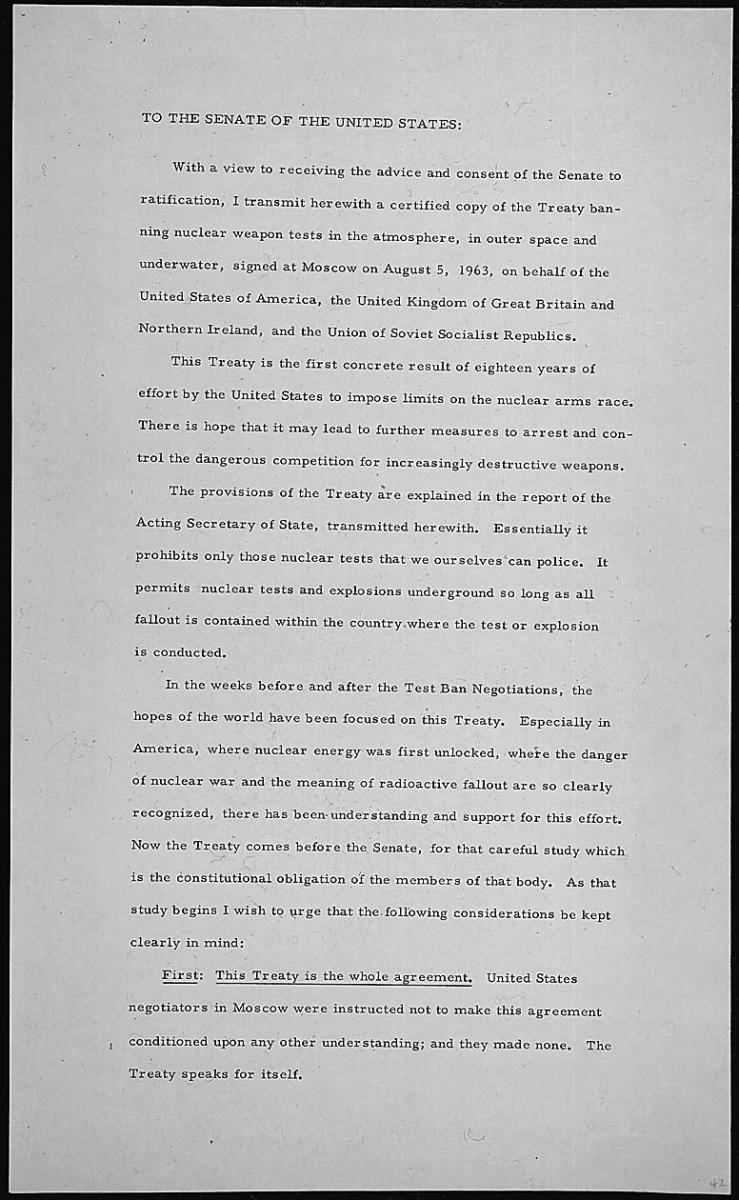
Message of President John F. Kennedy transmitting a treaty signed at Moscow on August 5, 1963, banning all nuclear weapons tests in the atmosphere, in outer space, and under water. RG 46, Records of the U.S. Senate, National Archives.
Not all international agreements are treaties—only those that are submitted to the Senate for its advice and consent. Executive Agreements are agreements between the United States and other nations that are not treaties and not submitted to the Senate. However, Executive Agreements are treated as treaties in the sense that they are binding under international law. Confusing, yes?
In this post, we are strictly looking at Senate records on treaties held by the Center for Legislative Archives in Record Group 46—Records of the United States Senate.
Senate treaty files may include a copy of the proposed treaty, a message from the President, a copy of the Committee on Foreign Relation's report, transcripts of hearings, committee prints, correspondence of committee chairpersons, correspondence indicating the administration's position, internal staff communications and analyses, tally sheets of committee votes, and, for treaties relating to taxation, a statement from the Joint Committee on Taxation and the Department of the Treasury. Treaty files that postdate the Legislative Reorganization Act of 1946, which authorized the creation of professional staff for committees, are more likely to contain fuller documentation.
In order to locate records on a particular treaty, researchers need to know the Congress in which the treaty was disposed of by the Senate and the parties to the treaty. This means that if the President submitted a treaty before one Congress and it was neither accepted nor rejected until the next Congress, records pertaining to the treaty are in the latter Congress. This disposition information can be located in either the Congressional Record and its antecedents, or in the Senate Executive Journal.
The Congressional Record is the record of proceedings and debate on the floor of the House and Senate, while the Senate Executive Journal (which is separate from the Senate's legislative journal) is a record of the Senate's executive proceedings relating to its function of confirming executive nominations and consenting to the making of treaties.
To give you a flavor of treaty documentation in Senate records, check out these documents available in the National Archives Catalog:
- the message from President John F. Kennedy transmitting to the Senate a treaty signed at Moscow on August 5, 1963 banning all nuclear weapons tests in the atmosphere, in outer space, and under water [see above];
- the treaty between the United States and the French Republic ceding the province of Louisiana to the United States; and
- Senator Henry Cabot Lodge's personal copy of his "Reservations" of the Treaty of Versailles; as Chairman of the Foreign Relations Committee he prepared a series of modifications to the Treaty to reflect isolationist sentiment.
Published and Online Sources of Treaty Information
The texts of treaties were published in the United States Statutes at Large until 1948. The Statutes at Large is the permanent collection of all laws and resolutions enacted during each session of Congress. The volumes are freely available online through GovInfo, a service of the Government Publishing Office.
Congress.gov—the official website for U.S. federal legislative information—has Treaty Documents from the 94th Congress (1975-1976) onward. Treaties submitted prior to the 94th Congress are included if they were pending in 1975.
Treaties in Force is an annual publication of the Department of State to provide information on treaties and other international agreements to which the United States has become a party, and which are carried on the records of the State Department as being in force as of its stated publication date.
For further reading, we suggest the following:
- Senate Consideration of Treaties (2017) from the Congressional Research Services;
- Treaties and Other International Agreements: the Role of the United States Senate (S.Prt.106-71, 2001) from the Senate Committee on Foreign Relations; and
- Researching Treaties and International Agreements, a research guide from the Law Library of Congress.
Other National Archives Records
Outside of the records of the U.S. Senate, the National Archives has other record groups with information on treaties. We also recommend researchers consult Record Group 59—General Records of the Department of State (start either with the U.S. Foreign Affairs Research portal or a search of the National Archives Catalog), and Record Group 11—General Records of the United States Government (see section 11.4 International Treaties and Related Records and the National Archives Catalog search results).
If you have a specific question about Senate records on treaties, please email us at legislative.archives@nara.gov.