
Presidential Library History
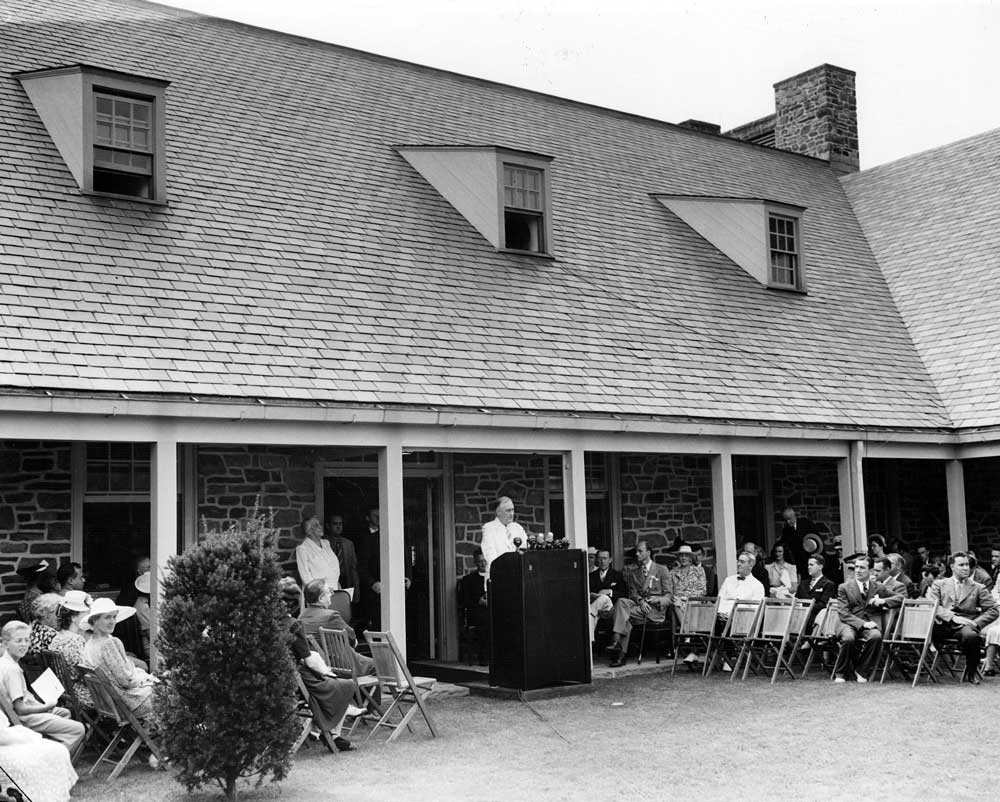
Franklin D. Roosevelt speaks at the dedication of his library in Hyde Park, NY, on June 30, 1941. (Franklin D. Roosevelt Library)
At the dedication of his library on June 30, 1941, Franklin Roosevelt observed:
"To bring together the records of the past and to house them in buildings where they will be preserved for the use of men and women in the future, a Nation must believe in three things. It must believe in the past. It must believe in the future. It must, above all, believe in the capacity of its own people so to learn from the past that they can gain in judgement in creating their own future."
The Presidential Library system formally began in 1939, when President Franklin Roosevelt donated his personal and Presidential papers to the Federal Government. At the same time, Roosevelt pledged part of his estate at Hyde Park to the United States, and friends of the President formed a non-profit corporation to raise funds for the construction of the library and museum building.
Roosevelt's decision stemmed from a firm belief that Presidential papers are an important part of the national heritage and should be accessible to the public. He asked the National Archives to take custody of his papers and other historical materials and to administer his library.
Many pre-Herbert Hoover collections of presidential papers now reside in the Library of Congress, while others are split among universities, libraries, historical societies, and private collections. Many materials have been lost or destroyed.
In 1950, Harry S. Truman decided that he, too, would build a presidential library to house his Presidential papers. In 1955, Congress passed the Presidential Libraries Act, establishing a system of federal “presidential archival depositories” across the United States. The Act encouraged other Presidents to donate their historical materials to the government and ensured the preservation of any donated Presidential papers and their availability to the American people. Under this and subsequent acts, more presidential archival depositories have been established, continuing the presidential libraries system.
The Presidential Records Act
Until 1974, Presidents, scholars, and legal professionals held the view dating back to George Washington that the records created by the President or his staff while in office remained the personal property of the President and were his to take with him when he left office. The first Presidential libraries were built on this concept. Many Presidents donated their historical materials to the Government to house at a Presidential library managed by NARA.
The Presidential Records Act of 1978 established that the Presidential records that document the constitutional, statutory, and ceremonial duties of the President are the property of the United States Government. After the President leaves office, the Archivist of the United States assumes custody of the records. The Act allowed for the continuation of the creation of presidential archival depositories for Presidential records.
The Presidential Libraries Act of 1986 also made significant changes to Presidential libraries, requiring private endowments linked to the size of the facility. NARA uses these endowments to offset a portion of the maintenance costs for the library.
Today, there is no single model for a presidential library in the Presidential Library system, but the National Archives always maintains responsibility for the preservation and access to the records and artifacts of the Presidential administration. The National Archives has individual partnerships with Presidential Foundations to maximize the public access to these records. In May 2017, for example, the Obama Foundation made the decision not to construct a Presidential Library for NARA to house the paper records and physical artifacts of the Obama presidency. Instead, the Obama Foundation plans to build and operate a private museum and presidential center in Chicago while the presidential archival depository is at the National Archives at College Park, Maryland. NARA retains legal and physical custody of the records and artifacts.