
Assessing Freedom of Information Act Compliance through the National Archives and Records Administration’s 2024 Records Management Self-Assessment
Published September 25, 2025 | Download the assessment
|
What NARA Collected |
|
|
Each year, the Chief Records Officer (CRO) for the U.S. Government at the National Archives and Records Administration (NARA) assesses whether federal agencies are complying with statutory and regulatory records management requirements. The Records Management Self-Assessment (RMSA) data collection includes several questions about the administration of the Freedom of Information Act (FOIA). The data collection ran from January 13, 2025 to March 14, 2025. |
|
|
Why We Included FOIA Questions |
|
|
A strong records management program—which allows agencies to find records responsive to FOIA requests—is essential to a successful FOIA program. Data collected in the RMSA helps OGIS fulfill its statutory mandate to review agency compliance with FOIA and complements the observations OGIS makes as the FOIA Ombuds, working to improve the FOIA process for all |
|
|
Key Results: FOIA Compliance through the 2024 Records Management Self-Assessment |
|
|
Artificial Intelligence (AI)
|
Almost one fifth (18.6 percent) of respondent agencies report using AI and/or machine learning in FOIA processing. OGIS Observation AI and machine learning have the potential to aid in FOIA processing, but are not a substitute for a FOIA professional’s judgment on application of exemptions and foreseeable harm. It is important that agencies explore the use of AI and/or machine learning options to help improve FOIA processing response times. |
|
FOIA Search |
Nearly half (46.6 percent) of respondents reported finding records responsive to a FOIA request that were beyond their retention period. OGIS Observation Disposing of records in accordance with NARA-approved disposition schedules can reduce the burden on the FOIA program as there may be fewer records to search for and process. It is therefore vital that agencies follow their records disposition schedules closely. |
|
FOIA Training |
The majority of respondents (81.3 percent) said that their Agency Records Officers (AROs) and records management (RM) staff have received some FOIA training, either formal or informal. OGIS Observation Records management training for FOIA professionals, and FOIA training for records management professionals, are crucial for the effective management of government information. It is critical that agencies ensure that FOIA and records management training (both formal and informal) is regularly made available to both sets of personnel. |
Background
Beginning with the 2016 Records Management Self-Assessment (RMSA), OGIS has partnered with the Chief Records Officer (CRO) for the U.S. Government at the National Archives and Records Administration (NARA) to collect government-wide information related to FOIA compliance. The CRO has issued the RMSA since 2009 to assess whether agencies are complying with statutory and regulatory records management requirements. It is a natural fit for OGIS to include FOIA questions in the RMSA data collection because a strong records management program—which allows agencies to find records responsive to a FOIA request—is essential to a successful FOIA program.
In working with the CRO, OGIS has leveraged investments by NARA in survey technology and the CRO’s expertise in collecting self-reported compliance information. The RMSA’s high response rate has helped OGIS better understand FOIA administration across the government and complements the observations we make through our other activities, including providing dispute resolution services to requesters and agencies, assessing FOIA compliance, and leading the Chief FOIA Officers Council and the federal FOIA Advisory Committee. Since Calendar Year (CY) 2018, the RMSA response rates have been at or above 95 percent, falling below—to 92 percent—only in CY 2020, when the self-assessment coincided with the start of the COVID-19 pandemic. This year’s response rate was 99 percent, with 280 responses from 284 invitees to the assessment.
The 2024 RMSA included seven questions regarding FOIA administration. Five questions have been asked in previous years, and two are new.
The five previously asked questions:
- a question (originally included on the 2019 RMSA) sought to survey Agency Records Officers (or records management staff) about the nature of FOIA training they receive;
- a question (included in the RMSA in 2020, 2021, and 2022) asked about the working relationship between the Agency Records Officer and the Chief FOIA Officer;
- a question (repeated from the 2020 and 2022 RMSAs) asked about the agency’s use of electronic discovery (e-discovery);
- for respondents who answered no to the e-discovery question, the next question (repeated from the 2020 and 2022 RMSA) asked why their agency does not use e-discovery tools; and
- a question regarding agency use of artificial intelligence (AI) and machine learning in FOIA searches.
The two new questions:
- for respondents who answered yes to the question regarding the agency’s use of e-discovery, a new question asked about how their offices obtained licenses for e-discovery tools; and
- a question regarding the incidence of record responsive to FOIA requests that had already surpassed their NARA-approved retention period.
The 2024 RMSA received a total of 280 responses from all Cabinet-level departments, departmental components, and independent agencies. Not all respondents answered all seven FOIA questions because some agencies may have skipped certain questions while respondents in the judicial branch are subject to the Federal Records Act (FRA) but not to the FOIA. The 12 judicial branch respondents were not included in the statistics for this report.
A complete list of the seven 2024 RMSA questions—each of which is discussed in detail below—is available in the Methodology section further below.
Discussion of results
Agencies are beginning to leverage Artificial Intelligence (AI) for FOIA searches and processing
Q53. Does your agency use artificial intelligence and/or machine learning to index/catalog/organize records to aid in searching for and retrieving records responsive to FOIA requests?
The results from the 2024 RMSA show that 18.6 percent of agencies that are subject to FOIA used artificial intelligence (AI) and/or machine learning to aid in the search and retrieval of records responsive to FOIA requests. The majority of agencies subject to FOIA (77.7 percent) reported not using AI or machine learning to conduct FOIA searches in 2024.
Of the 269 respondents subject to FOIA, 50 reported using AI or machine learning for FOIA searches, while 209 reported not using AI. Ten respondents answered “do not know.”
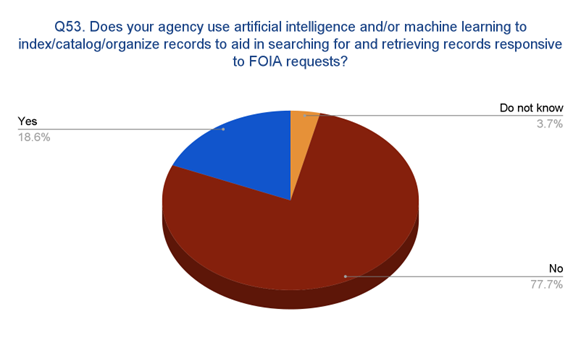
Figure 1
2024 RMSA Responses to Question 53 “Does your agency use artificial intelligence and/or machine learning to index/catalog/organize records to aid in searching for and retrieving records responsive to FOIA requests?”
Observations
AI and machine learning are revolutionizing the way information is stored and processed across all sectors of society. Growing awareness of these tools has led to increased interest in applying them to new areas for increased efficiency. The FOIA Advisory Committee in its 2022-2024 term examined potential areas where FOIA processing could benefit from AI and machine-learning tools. Recognizing that agencies would benefit from proactively seeking industry input, the Committee recommended that “the Chief FOIA Officers Council Technology Committee and interested agencies publish requests for information (RFIs) on the subject of artificial intelligence (AI) tools and techniques as an aid to FOIA processing.” (Recommendation 2024-12). The Technology Committee is currently preparing a draft RFI in response to this recommendation.
It is notable that in this year's RMSA almost one fifth (18.6 percent) of respondent agencies reported using AI and/or machine learning in FOIA processing. While the majority of FOIA offices have yet to deploy this technology, the early adopters are demonstrating the ability of AI to identify sensitive information, and normalizing the concept of AI in FOIA processing.[1]
AI and machine learning have the potential to aid in FOIA processing, but are not a substitute for the judgment of FOIA professionals on application of exemptions and foreseeable harm. It is important that agencies explore the use of AI and/or machine learning options to help improve FOIA processing response times.
Use of e-Discovery Tools
In 2020, the FOIA Advisory Committee recommended that the U.S. Department of Justice, Office of Information Policy (OIP), provide guidance to agencies on the use of e-discovery tools to assist agencies in their searches of electronic records in response to FOIA requests. (Recommendation 2020-11). Agencies continue to report annually in their Chief FOIA Officer (CFO) Reports on their efforts to leverage e-discovery and other tools, and OIP continues to encourage agencies to leverage technology for greater efficiency. Moreover, the CFO Council’s Technology Committee continues to study ways e-discovery can improve FOIA processing. The 2024 RMSA included questions about e-discovery to assess the current landscape across FOIA programs governmentwide.
The results from the 2024 RMSA show that many FOIA offices are able to leverage e-discovery tools. The three questions on this topic asked agencies whether they used e-discovery tools, then either how they manage licenses or their reasons for not using e-discovery. This data appears to indicate that agencies generally have access to these tools if they are needed.
Q54. Does your agency use e-discovery tools to search for records when responding to FOIA requests and/or Legal Discovery?
The second FOIA question in the 2024 RMSA is repeated from the 2020 and 2022 RMSAs and asked about the use of e-discovery tools to search for records in response to FOIA requests and/or legal discovery. In 2024, there were 269 respondents who were subject to FOIA. Almost three quarters of respondents (73.6 percent) reported using e-discovery for FOIA or legal discovery, and over one fifth (21.6 percent) reported not using e-discovery. Additionally, 4.8 percent of respondents did not know.
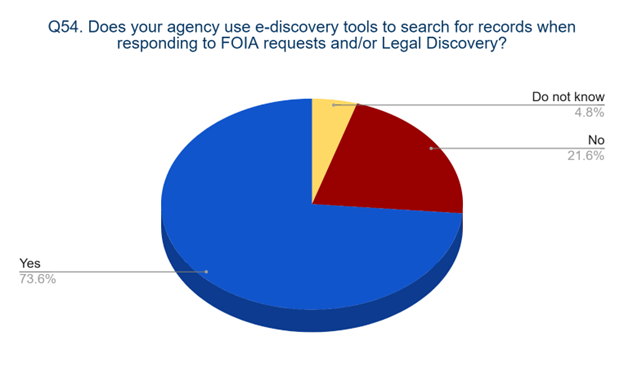
Figure 2
2024 RMSA Responses to Question 54 “Does your agency use e-discovery tools to search for records when responding to FOIA requests and/or Legal Discovery?”
In the three RMSAs where this question has appeared, there has been a slight variation in the percentage of respondents who use e-discovery tools to search for records responsive to a FOIA request. This variation is likely due to the number of respondents subject to FOIA. In the 2020 RMSA, with 266 respondents to this question who were subject to FOIA, 72 percent answered “yes.” In 2022, with 253 respondents subject to FOIA, 75 percent of respondents subject to FOIA answered “yes.” In 2024, with 269 respondents subject to FOIA, 74 percent answered “yes.” Unlike in previous years, no comments stated that they did not know what e-discovery is.
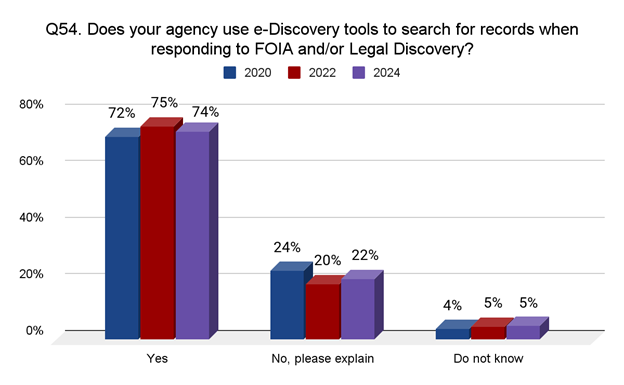
Figure 3
RMSA Responses 2020-2024 to Question 54 “Does your agency use e-discovery tools to search for records when responding to FOIA requests and/or Legal Discovery?”
Q55. If yes: Which of the following applies?
This question asked agencies that use e-discovery how they obtain the licenses and received 194 responses. Over half (57.2 percent) reported that the FOIA office is using existing licenses or tools from other offices. Over 14 percent (14.4 percent) reported that the FOIA office purchased its own office-specific tools. Over a quarter of the respondents (26.8 percent) selected “other” and provided an explanation, and 1.5 percent did not know. Since this question applied only to respondents who answered yes to Q54, there were no respondents for whom this was not applicable.
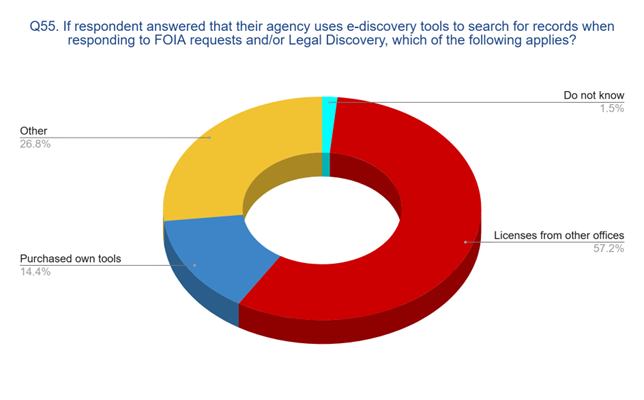
Figure 4
2024 RMSA Responses to Question 55: for agencies that use e-discovery tools to search for records when responding to FOIA requests and/or Legal Discovery “Which of the following applies?”
|
Theme |
Selected Agency Comments |
|---|---|
|
Borrows licenses from other offices |
“Yes, our agency uses e-discovery tools to search for and manage records in response to both FOIA requests and legal discovery. These tools help us efficiently locate, identify, and review relevant records, ensuring compliance with legal and regulatory obligations.” |
|
“[This office] is one component of [the agency]. We utilize the [agency]-wide eDiscovery tool.” |
|
|
Uses FOIA-specific search tool |
“The FOIA office purchased its own office-specific tools AND the FOIA office is using existing licenses or tools from other offices in my agency.” |
|
“The agency’s Office of General Counsel uses e-discovery tools for Litigation Discovery. The agency’s FOIA program utilizes a tool optimized for FOIA when responding to administrative FOIA requests.” |
|
|
Uses tool included in software suite |
““[The agency] has a more robust search capability utilizing [software provider's] ecosystem for records searches, but e-Discovery is an indispensable tool for then deduplicating, threading, and processing the records located pursuant to the [software] search capability.” |
|
“[The software] provides eDiscovery capabilities and is included in our licenses. FOIA [and other] personnel, and eDiscovery members can request access to this feature in order to provide data loss prevention or discovery functions.” |
|
|
“Ediscovery / Content Search applications part of [software] enterprise license” |
Table 1: Selected data from 2024 RMSA “Other, please explain,” Responses to Question 55: for agencies that use e-discovery tools to search for records when responding to FOIA requests and/or Legal Discovery “Which of the following applies?”
Q56. If No: Why are e-discovery tools not used to search for records? (Choose all that apply)
The question asking for reasons why e-discovery is not used to search for records got a total of 58 responses in the 2024 RMSA. This question, repeated from the 2020 and 2022 RMSAs, allowed respondents to select more than one choice. The most common reason, selected by 48 percent (48.3 percent) of respondents, was that the e-discovery tools are not available at their agency. Almost 40 percent (39.7 percent) of respondents responded that “cost” was a reason they did not use e-discovery tools. A small number of respondents (3.4 percent) reported that they did not use e-discovery tools because of a “limited number of licenses available;” 31 percent of respondents selected “other” with an explanation; and 10 percent of respondents did not know.
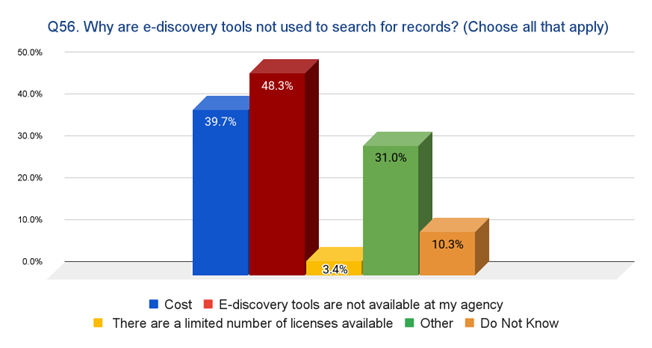
Figure 5
2024 RMSA Responses to Question 56 “Why are e-discovery tools not used to search for records?”
In comparing responses to this question from the 2020 RMSA and the 2022 RMSA, the data appears to indicate that many respondents who do not use e-discovery tools have gained an awareness of the tools. Notably, unlike in previous years, no respondent commented on not knowing what e-discovery was. The trend across the three RMSAs where this question has appeared is the decline in the percentage of respondents who selected “other.” In the 2020 RMSA, 56 percent of respondents selected “other, please explain,” dropping to 37 percent on the 2022 RMSA, and falling further to 31 percent on this year's RMSA.
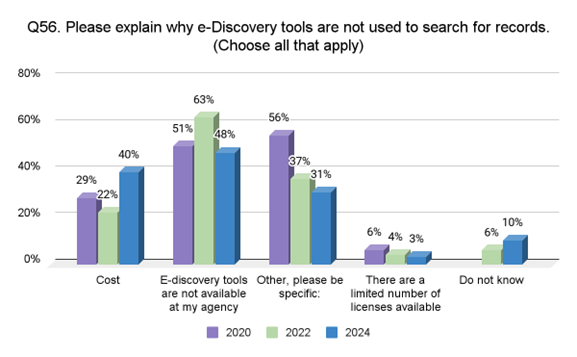
Figure 6
RMSA Responses 2020-2024 to Question 56 “Why are e-discovery tools not used to search for records?”
As shown in Table 2, the “Other, please be specific” comments in the most recent RMSA show that many agencies that do not currently use e-discovery tools either do not need them because they receive so few FOIA requests so as to make e-discovery tools unnecessary or they are working to establish this technology at their agency. Of the 18 respondents who gave an explanation, seven of them (39 percent) cited the small size of their agency or small number of FOIA requests as a reason for not using e-discovery tools.
|
Theme |
Selected Agency Comments |
|---|---|
|
Decentralized agencies do not have access to all records |
“As [an office within a larger agency], we have no access to or purview over records at the HQ. The records at the HQ are decentralized with each [group] having operational control of their own records and management systems.” |
|
“[The agency] does not use e-discovery to search for records, this is done by the program offices within the organization. We utilize e-discovery to manage, process, and maintain the FOIA requests and responsive records.” |
|
|
Agencies setting up e-discovery |
“Purchased eDiscovery software but it has not [been approved] yet.” |
|
“The FOIA Division is pursuing the [acquisition] process to obtain e-discovery software for FY26.” |
|
|
E-discovery unnecessary at some small agencies |
“Not enough FOIA requests to justify the expense.” |
|
“[The agency] does not require the use of e-discovery tools to search for records in light of the number and nature of FOIA requests received annually.” |
|
|
“[The agency] is a micro agency with a staff of [fewer than 15] full-time employees. It receives a limited number of FOIA requests each year and relatively few complex requests. The use of e-Discovery tools is neither necessary nor cost effective.” |
|
|
“We are a small office of [fewer than 15] employees: all of our records can be found on our internal server.” |
Table 2: Selected Data from 2024 RMSA “Other, please explain,” Responses to Question 56 “Why are ediscovery tools not used to search for records. (Choose all that apply)”
Observations
The data indicates that e-discovery tools are widely used across government agencies to conduct FOIA searches, a situation which has held steady for the past four years. Seventy-two percent of respondents reported using e-discovery for FOIA on the 2020 RMSA, 73 percent of respondents reported doing so on the 2022 RMSA, and 73.6 percent reported using them on the 2024 RMSA.
Many of the FOIA offices that use e-discovery (57.2 percent) cooperate with other offices in their agencies to share software licenses. The percentage of respondents who reported using e-discovery for FOIA searches shows minimal variation across the RMSAs from 2020, 2022 and 2024.
Records Retention Schedules and FOIA
By law, all federal records must be covered by a NARA-approved records schedule,[2] and agencies must not destroy records until they are approved for destruction on an approved records schedule. (44 U.S.C. § 3314). An approved records schedule is a legal authority that identifies and allows for disposal of a federal agency's records. When NARA approves a records schedule, it considers how long a type of record will be valuable to determine whether those records have enough value to warrant permanent preservation or how long they should be retained before being destroyed. (44 U.S.C. §§ 3303 and 3303a.) Only records that do not appear to have sufficient administrative, legal, research or other value can be destroyed after a retention period laid out in a records schedule.
Implementing a records schedule is mandatory for legal compliance and good records management. Doing so saves taxpayer money by authorizing the destruction of records that are not needed, minimizes the risk that records with privacy or other protected information are accidentally released, and prevents premature or delayed destruction of records.[3] However, if an agency retains a record past its approved records schedule, the agency must process the record if it is responsive to a FOIA request. In such a case, the agency must retain it through the entire FOIA process, including appeals and litigation, before being able to dispose of the record.
Q57. Has your agency found records responsive to FOIA requests that had already met their approved retention period (i.e., the records should have already been disposed of under your agency’s NARA-approved records schedules)?
This question received 277 responses. Over 46 percent (46.6 percent) of respondents reported finding records responsive to a FOIA request that were beyond their retention period. Over 36 percent (36.5 percent) of respondents reported not finding records that had surpassed their retention period. Seventeen percent of respondents did not know.
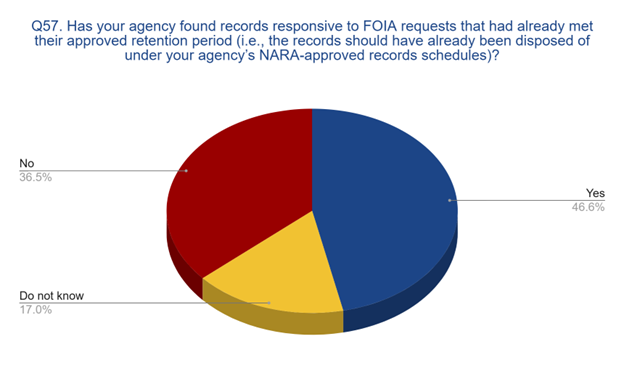
Figure 7
2024 RMSA Responses to Question 57 “Has your agency found records responsive to FOIA requests that had already met their approved retention period (i.e., the records should have already been disposed of under your agency’s NARA-approved records schedules)?”
Observations
This data points to an issue with records management: specifically, the need to dispose of records once they meet their retention period. For a FOIA program, reviewing records that have surpassed their retention period adds to the volume of records the FOIA processor has to review and could slow down processing time and add to delays, creating inefficiencies. NARA’s approval of a records schedule is an official determination of how long records are valuable, and retaining records past that time could burden an agency when faced with FOIA requests, in addition to the cost of storing records. Solid records management practices are the foundation for a strong FOIA program. It is therefore vital that agencies follow their records disposition schedules closely.
Agency Records Officers and Chief FOIA Officers
OGIS has long been interested in the relationship between Agency Records Officers (AROs), and Chief FOIA Officers (CFOs), who are mandated by statute to ensure compliance with the FRA and FOIA, respectively. AROs are senior officials within each agency whose responsibilities include oversight of records management, and CFOs are senior officials within each agency whose responsibilities include “efficient and appropriate compliance” with FOIA and recommending FOIA improvements to the head of the agency.
Q58. Which of the following describes the working relationship between the Agency Records Officer and the Chief FOIA Officer?
This question asked respondents to describe the working relationship between the ARO and CFO at their agency by choosing all statements that applied. The question about the relationship between the two is repeated from the 2020, 2021 and 2022 RMSAs. Additionally, the 2017 RMSA asked how closely the ARO and the CFO worked together.
For the 2024 RMSA, this question had 268 respondents who were subject to FOIA. Since respondents were able to select all applicable answers, the responses will not add up to 100 percent.
The responses in the 2024 RMSA include: 37 percent said that the ARO and CFO coordinate search terms to identify responsive records; 42 percent reported that the two work together to identify programs or offices most likely to have responsive records; 43 percent reported that the two work together on high-profile or complex FOIA requests; 36 percent reported providing training on records management and FOIA to each other's staff; 37 percent reported providing training programs on the importance and relationship between FOIA and records management; 24 percent responded “Other, please explain;” and 9 percent answered, “None of the above.” Additionally, 7 percent of respondents reported that the ARO and the CFO are the same person.
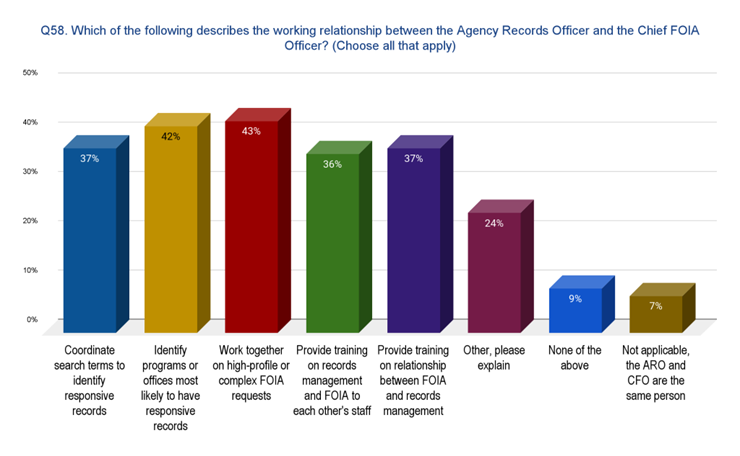
Figure 8
2024 RMSA Responses to Question 58 “Which of the following describes the working relationship between the Agency Records Officer and the Chief FOIA Officer?”
Looking at the responses over several years’ worth of RMSAs where this question has appeared shows two main trends. First, the responses that are consistent over several years are that the ARO and CFO coordinate search terms to identify responsive records and that the two work together on high-profile or complex FOIA requests. Second, there is a downward trend in training. Both training options (provide training on records management and FOIA to each other's staff and provide training programs on the importance and relationship between FOIA and records management) have been selected by fewer respondents in each of the past three times this question has appeared on the RMSA.
The 2020 RMSA did not include a selection choice for agencies where the ARO and the CFO are the same person. This was a frequent explanation given in response to “other,” and was included in subsequent RMSAs. The 2024 RMSA left off the selection choice for working together on IT requirements that benefit both programs.
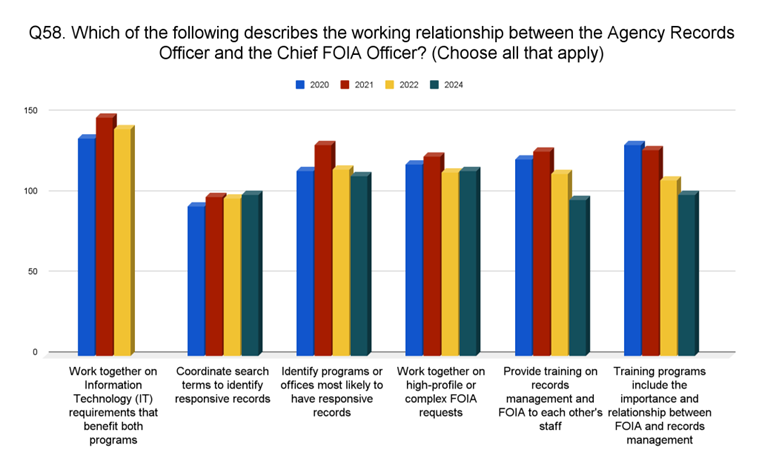
Figure 9
RMSA Responses 2020-2024 to Question 58 “Which of the following describes the working relationship between the Agency Records Officer and the Chief FOIA Officer?”
Observations
OGIS finds it encouraging that CFOs and AROs continue to coordinate search terms to identify responsive records and that at many agencies the two work together on high-profile or complex FOIA requests. Nevertheless, the results also point to room for improving cross-training for FOIA and records management (RM) staffs.
FOIA Training for Agency Records Officers and Records Management Staff
The FOIA statute requires agencies’ CFOs, subject to the authority of the head of the agency, to offer training to agency staff regarding their responsibilities under FOIA (5 U.S.C. § 552(j)(2)(F)), and there has been renewed interest in FOIA training for non-FOIA professionals. The FOIA Advisory Committee has issued two recommendations regarding training: one recommending that NARA and OIP create training modules mainly directed at FOIA officers and FOIA Public Liaisons that include records management (2020-04); and another recommendation seeking FOIA training for all agency staff (2024-04). Recommendation 2024-04 states that “the Department of Justice Office of Information Policy (OIP) should issue guidance to all Chief FOIA Officers outlining the minimum requirements for training to agency staff, including non-FOIA professionals.” The Department of Justice Office of Information Policy subsequently issued guidance on FOIA training and the role of the CFO.[4]
Q59. As the Agency Records Officer (or records management staff), have you received FOIA training?
This question, which asked if the ARO or records management (RM) staff received FOIA training, was repeated from the 2019 RMSA. It received 277 responses in 2024.
The majority of respondents (81.3 percent) said that their ARO or RM staff have received some FOIA training, either formal or informal. Forty-five percent of respondents said that their ARO or RM staff received formal FOIA training such as online training or in-person instructor-led training. Thirty-nine percent of respondents said that they received informal FOIA training such as a briefing or as part of their agency’s employee orientation process. Eighteen percent of respondents said that their ARO or RM staff did not receive any FOIA training. An additional one percent responded, “do not know.” (Percentages are rounded and may not equal 100 percent.)
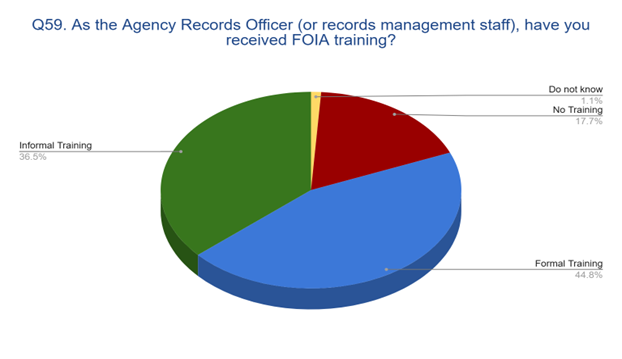
Figure 10
2024 RMSA Responses to Question 59 “As the Agency Records Officer (or records management staff), have you received FOIA training?”
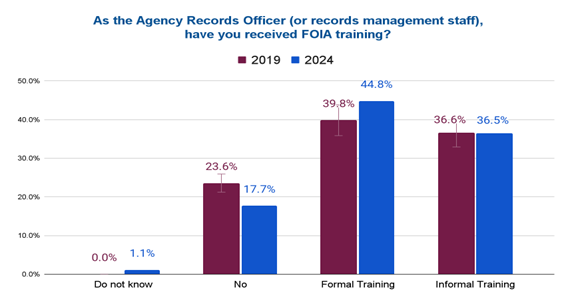
Figure 11
RMSA Responses 2019 and 2024 to Question 59 “As the Agency Records Officer (or records management staff), have you received FOIA training?”
Comparing this year's results with the results of the 2019 RMSA shows a 5-percentage point increase in respondents who reported receiving formal training. That change, along with the 1-percentage point increase in respondents who did not know, corresponds to the 6-percentage point decrease in respondents reporting having received no training. The percentage of respondents reporting informal training held steady.
Observations
These results indicate that some agencies have made progress in implementing formal training on FOIA issues. It is noteworthy that the percentage of agencies who reported informal training is consistent between the two RMSAs where this question appeared.
There does not appear to be a pattern of which agencies reported informal versus formal training, with different agencies in the same cabinet-level department reporting differently. It could be that the informal training, on an individual-to-individual level, is more efficient or valuable than the formal training conducted on an online module or large seminar, and thus top-of-mind to respondents. The 1 percent who reported not knowing whether they had received training may point to the ineffectiveness of the training they had received.
Records management training for FOIA professionals, and FOIA training for records management professionals are crucial for the effective management of government information. It is critical that agencies ensure that FOIA and records management training (both formal and informal) is regularly made available to both sets of personnel.
Conclusion
OGIS’s collaboration with the CRO in its annual RMSA helps us fulfill our statutory mission to “identify procedures and methods for improving compliance” under FOIA. Records management and FOIA are both essential to government transparency and both are central to ensuring a responsive and efficient government. As OGIS often notes, strong records management programs support effective FOIA programs by helping to identify and locate requested records quickly and efficiently.
For the 2024 RMSA, we are encouraged that the majority of respondents (81.3 percent) said that their ARO or RM staff have received either formal or informal FOIA training. We are hopeful that the continued implementation of AI and machine learning will bring about faster and less resource-intensive FOIA processing. This technology has the potential to help alleviate backlogs and improve FOIA administration throughout the federal government. The 2024 RMSA has yielded data which informs the efforts of OGIS, the Chief FOIA Officers Council, and the FOIA Advisory Committee in working toward a FOIA process that works for all.
Methodology
The CRO’s office opened the 2024 RMSA on January 13, 2025, with a response deadline of March 14, 2025. The CRO’s office conducts the RMSA via an online survey tool that creates a unique link used to submit responses in accordance with NARA’s responsibility to report on the state of federal records management. Each year, federal agencies are required to conduct an RMSA and submit their findings to NARA. Ninety-nine percent of agencies that received the 2024 RMSA link completed the assessment. The goal of the self-assessment is to determine whether federal agencies are in compliance with statutory and regulatory records management requirements.
A total of 280 agencies responded to the RMSA, but not all respondents answered the FOIA questions. (Questions 53 – 59 pertained to FOIA.) The respondents included records officers at all Cabinet-level departments, departmental components, and independent agencies. Twelve non-executive branch agencies that are not subject to FOIA (but are subject to records management requirements) took part in the assessment. CRO instructed agency RMs to consult with their agency FOIA Officers to answer the FOIA-related questions.
Percentages are rounded up and, for some questions, may not equal 100 percent, particularly where respondents could select more than one answer.
The full 2024 RMSA report is one of three reports required by the CRO, the results of which are included in the Federal Agency Records Management Annual Report to Congress, published on NARA’s website on the CRO’s RMSA web page.
List of Statistical Results from 2024 RMSA FOIA questions
|
Q53. Does your agency use artificial intelligence and/or machine learning to index/catalog/organize records to aid in searching for and retrieving records responsive to FOIA requests? |
|||
|
Answer Option |
Count per answer option |
Percentage subject to FOIA |
Percentage of total responses |
|
Yes, please describe: |
50 |
19% |
18% |
|
No |
209 |
78% |
75% |
|
Do not know |
10 |
4% |
4% |
|
Not applicable, my agency is exempt from FOIA |
10 |
N/A |
4% |
|
Q54. Does your agency use e-discovery tools to search for records when responding to FOIA requests and/or Legal Discovery? |
|||
|
Answer Option |
Count per answer option |
Percentage subject to FOIA |
Percentage of total responses |
|
Yes |
198 |
74% |
71% |
|
No |
58 |
22% |
21% |
|
Do not know |
13 |
5% |
5% |
|
Not applicable, my agency is exempt from FOIA |
10 |
N/A |
4% |
|
Q55. If yes on 54: Which of the following applies? |
|||
|
Answer Option |
Count per answer option |
Percentage subject to FOIA |
|
|
FOIA office purchased its own office-specific tools |
28 |
15% |
|
|
FOIA office is using existing licenses or tools from other offices in my agency |
111 |
58% |
|
|
Other, please explain |
52 |
27% |
|
|
Do not know |
3 |
2% |
|
|
Q56. If No: Why are e-discovery tools not used to search for records? (Choose all that apply) |
|||
|
Answer Option |
Count per answer option |
Percentage subject to FOIA |
|
|
Cost |
23 |
31% |
|
|
E-discovery tools are not available at my agency |
28 |
37% |
|
|
There are limited number of licenses available |
0 |
0% |
|
|
Other, please be specific: |
18 |
24% |
|
|
Do not know |
6 |
8% |
|
|
Q57. Has your agency found records responsive to FOIA requests that had already met their approved retention period (i.e., the records should have already been disposed of under your agency’s NARA-approved records schedules)? |
|||
|
Answer Option |
Count per answer option |
Percentage subject to FOIA |
|
|
Yes |
129 |
47% |
|
|
No |
101 |
36% |
|
|
Do not know |
47 |
17% |
|
|
Q58. Which of the following describes the working relationship between the Agency Records Officer and the Chief FOIA Officer? |
|||
|
Answer Option |
Count per answer option |
Percentage subject to FOIA |
Percentage of total responses |
|
Coordinate search terms to identify responsive records |
100 |
16% |
16% |
|
Identify programs or offices most likely to have responsive records |
112 |
18% |
17% |
|
Work together on high-profile or complex FOIA requests |
115 |
18% |
18% |
|
Provide training on records management and FOIA to each other's staff |
97 |
15% |
15% |
|
Provide training programs on the importance and relationship between FOIA and records management |
100 |
16% |
16% |
|
Other, please explain |
65 |
10% |
10% |
|
None of the above |
24 |
4% |
4% |
|
Not applicable, the Agency Records Officer and the Chief FOIA Officer are the same person |
20 |
3% |
3% |
|
Not applicable, my agency is exempt from FOIA |
11 |
N/A |
2% |
|
Q59. As the Agency Records Officer (or records management staff), have you received FOIA training? |
|||
|
Answer Option |
Count per answer option |
Percentage subject to FOIA |
|
|
Yes, I have received informal FOIA training (briefed by a colleague or as part of agency employees orientation) |
101 |
36% |
|
|
Yes, I have received formal FOIA training (online or in-person instructor-led session) |
124 |
45% |
|
|
No |
49 |
18% |
|
|
Do not know |
3 |
1% |
|
[1] The final report of the 2022-2024 term of the FOIA Advisory Committee notes on page 30, “Of special interest is the work being conducted at the State Department, where efforts are underway to incorporate into FOIA search and review processes gains leveraged from using AI machine-learning tools for the purpose of declassifying a set of State Department historical cables.” (https://www.archives.gov/files/ogis/documents/finalreport.6.17.24.pdf).