
The Freedom of Information Act Ombudsman 2026 Report for Fiscal Year 2025
Download The Freedom of Information Act Ombudsman 2026 Report for Fiscal Year 2025
Published May 29, 2026
Message from the Director
Congress established the Office of Government Information Services (OGIS) to serve as a neutral, independent resource for the public and federal agencies navigating the Freedom of Information Act (FOIA). As the federal FOIA Ombuds, our mission is rooted in both service and oversight: resolving disputes through impartial assistance and reviewing agency FOIA practices to identify opportunities for systemic improvement.
In fiscal year (FY) 2025, OGIS continued to fulfill this dual mandate with dedication and purpose. We responded to more than 6,000 requests for assistance, issued a comprehensive agency assessment of the Department of Veterans Affairs FOIA program, published two Ombuds Observers regarding FOIA issues, and administered the sixth term of the FOIA Advisory Committee.
We assisted FOIA requesters and FOIA professionals alike during a period of significant change across the federal government. Between FY 2024 and FY 2025, the number of full-time FOIA staff at all 15 Cabinet-level departments and 10 independent agencies decreased 16 percent while backlogs across those agencies increased by 27 percent.[1] OGIS offered a steady hand through it all— advocating for a fair, effective, and accessible FOIA process.
Our public engagement efforts included a 2025 Sunshine Week program, the statutorily mandated OGIS Annual Open Meeting, and continued interagency collaboration via the Chief FOIA Officers Council. These activities help ensure OGIS is aware of the FOIA landscape and that our work is both responsive and forward-looking.
We are proud to present our FY 2025 Annual Report to the House Committee on Oversight and Government Reform, the Senate Committee on the Judiciary, and the President on our work, which demonstrates our ongoing commitment to improving the FOIA process.[2]
As we reflect on this year’s accomplishments, I am proud of the steadfast commitment of the OGIS team. Through careful observation, constructive engagement, and a deep respect for the FOIA process, we remain dedicated to fostering transparency, building trust, and ensuring that the FOIA system functions fairly and effectively for all stakeholders.
The views expressed in this report are those of the OGIS Director and do not necessarily represent the views of the President, 5 U.S.C. § 552(h)(4)(C).
Sincerely,

Alina M. Semo, Director
Office of Government Information Services
Executive Summary
In FY 2025, requesters and FOIA professionals turned to the Office of Government Information Services (OGIS) seeking assistance during a period of significant change across executive branch agencies and the broader FOIA landscape. Throughout, OGIS continued its work as the federal FOIA Ombuds—providing impartial assistance to customers and identifying practical ways to improve FOIA compliance governmentwide. As the federal FOIA Ombuds, we serve as a resource for information and assistance regarding the FOIA process. We are impartial in that we advocate for a fair and equitable FOIA administrative process rather than for the interests of either FOIA requesters or agencies. We are a trusted neutral third party and protect the identities of and communications with those who seek our assistance.
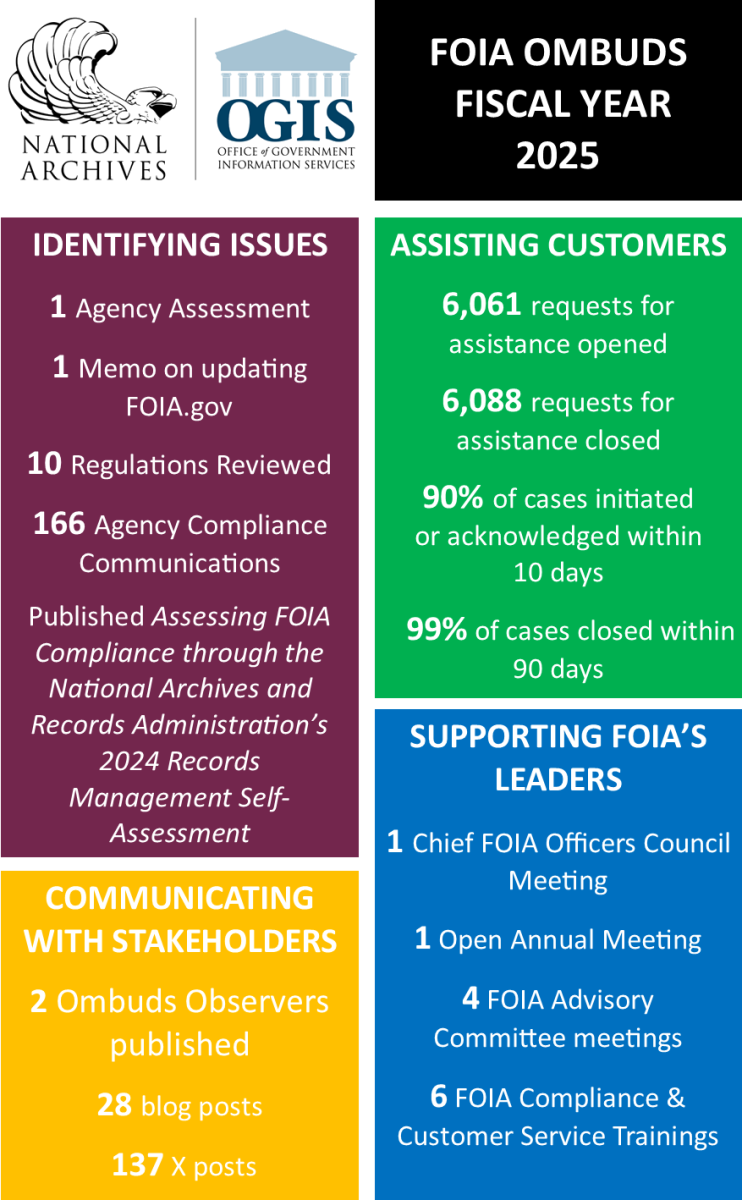
- OGIS provided timely mediation and assistance, handling 6,061 cases and closing 6,088 — with 90% initiated or acknowledged within 10 days of date logged and 99% closed within 90 days. These cases remain a vital source of insight into system-wide FOIA challenges.
- OGIS published a congressionally mandated assessment of the U.S. Department of Veterans Affairs FOIA program, with 10 findings and 15 recommendations for improvement.
- Through 28 blog posts and 137 X posts, OGIS continued its online outreach. Public comments and open meetings provided vital feedback loops, helping shape the national FOIA dialogue.
- OGIS convened the 2025 Sunshine Week program that focused on transparency and access, the OGIS Annual Open Meeting, one Chief FOIA Officers (CFO) Council meeting and four FOIA Advisory Committee meetings—all aimed at fostering dialogue on important FOIA matters.
- OGIS chaired and managed the FOIA Advisory Committee, composed of representatives from inside and outside the government, which worked on three subcommittees: Implementation, Statutory Reform, and Volume and Frequency.
- OGIS issued two Ombuds Observers, one focused on estimated dates of completion challenges and a second highlighting how requesters can use FOIA to access records held by Intelligence Community agencies.
- OGIS reviewed 10 agency FOIA regulations and engaged in 166 compliance communications, alerting agencies about FOIA compliance issues.
- Finally, through the Records Management Self-Assessment, to which 99% of agencies responded, OGIS gleaned key insights about the use of artificial intelligence (AI) and machine learning in FOIA processing; records retention; and FOIA training.
The FOIA Landscape
Between FY 2024 and FY 2025, the number of full-time FOIA staff at 15 Cabinet-level departments and 10 independent agencies decreased by 16 percent.[3] Agencies reporting the deepest cuts included:
- Department of Education (54 percent)
- Department of the Treasury (39 percent)
- Department of Veterans Affairs (36 percent)
- General Services Administration (33 percent)
- Department of Housing and Urban Development (32 percent)
- Department of Homeland Security (30 percent)
- U.S. Agency for International Development (30 percent)
- Department of Commerce (26 percent)
- Department of State (26 percent)
During the same period between FY 2024 and FY 2025, backlogs increased 27 percent at the 15 Cabinet-level departments and 10 independent agencies.[4] Requesters contacted OGIS with questions regarding the current status of agency FOIA programs. To position itself to assist these requesters and fulfill its statutory compliance mandate, OGIS worked with agencies to confirm or establish points of contact and understand new processes.


Assisting Customers
Congress created OGIS in 2007 to serve as the federal government’s FOIA Ombuds,[5] directing us to review agencies’ policies, procedures, and compliance with FOIA, and to offer mediation services to resolve disputes between FOIA requesters and agencies.[6]
Requesters and agencies contact OGIS for assistance at every stage in the FOIA process. We strive to meet requesters where they are in the process, whether to clarify the administrative path forward for an inexperienced requester or engage in complex issues raised by a seasoned FOIA stakeholder.
Our mediation cases serve as a governmentwide barometer of the FOIA process and provide a valuable mechanism for listening to and observing the experiences of FOIA requesters. This work is vital to our statutory mandate to identify procedures and methods to improve overall compliance with FOIA.
Requests for our assistance, particularly in the last three quarters of FY 2025 (January 2025 - September 2025), sought help with understanding and navigating the FOIA process during a period of significant change affecting the federal workforce.
In this environment, OGIS offered neutral and steady assistance, helping requesters navigate the process, and keeping up with the continued demand for our services in FY 2025:
- 6,061 requests for assistance received
- 6,088 requests for assistance closed
- 90% of requests initiated/acknowledged in 10 days of date logged
- 99% of requests closed within 90 days
Communicating with Stakeholders
OGIS recognizes the significance of communicating with individuals and organizations who navigate through the federal FOIA landscape, and we value hearing from stakeholders beyond those who seek our assistance. Written public comments are an important way for OGIS as well as the FOIA Advisory Committee and Chief FOIA Officers Council (which the OGIS Director chairs and co-chairs, respectively) to better understand the experiences of FOIA requesters.
OGIS continues to engage with stakeholders through its social media presence. In FY 2025, OGIS published 28 blog posts and 137 social media posts. As a trusted, neutral resource for FOIA stakeholders, OGIS uses these avenues for important conversations about FOIA.
Supporting FOIA’s Leaders
OGIS aims to support FOIA’s leaders in a variety of ways. In FY 2025, we offered a mix of public events and training to help meet this need.
Public Events
The 2025 Sunshine Week event was offered virtually on the National Archives YouTube Channel. The program consisted of a panel discussion on “Transparency and Access to NARA Records.” Jill Reilly, NARA’s Acting Chief Innovation Officer, moderated the forum, which included a discussion with National Archives officials about NARA’s commitment to maximizing transparency and providing access to records. The discussion focused on NARA’s efforts to digitize its records, leverage artificial intelligence, and improve its online experience for researchers. Panelists were Denise Henderson, Director of Digitization; Michael Knight, Director of Web Division; and Carol Lagundo, Director of Digital Partnerships and Outreach.
Our 2025 OGIS Annual Open Meeting on July 23, 2025, allowed us to review the previous year’s work, including publication of the Ombuds Observer NCND/Glomar: When Agencies Neither Confirm Nor Deny the Existence of Records, and the launching of the sixth term of the FOIA Advisory Committee.
And in FY 2025, we continued to host meetings of the Chief FOIA Officers Council and the FOIA Advisory Committee, which were held virtually and livestreamed on the National Archives YouTube channel.
Chief FOIA Officers Council
As Congress mandated with the passage of the FOIA Improvement Act of 2016,[7] the Directors of OGIS and the Office of Information Policy (OIP) at the U.S. Department of Justice co-chair the Chief FOIA Officers (CFO) Council. The Council, its two Committees, and working groups met several times throughout FY 2025. This included hosting one public Council meeting on November 7, 2024, during which OIP, OGIS and Council subcommittees reported updates.
FOIA Advisory Committee
The OGIS Director chairs the FOIA Advisory Committee, established by the Archivist of the United States in 2014. The Committee’s work helps us fulfill the directive in FOIA that OGIS “identify procedures and methods for improving compliance” with FOIA.[8] The Committee is composed of 20 members representing both the requester community and FOIA professionals from a range of federal departments and agencies who are appointed by the Archivist of the United States to study the FOIA landscape and make recommendations for improvements.
The sixth term of the Committee began its work in September 2024 and is expected to complete its work late in FY 2026. The changes to the federal workforce caused the resignation of four of the 10 government members in early calendar year 2025. Committee members persevered and continued developing concrete recommendations to reform the FOIA statute; examine challenges arising from the increasing volume and frequency of FOIA requests; and increase the adoption and implementation of past FOIA Advisory Committee recommendations.
Providing Targeted Training
Our training outreach continued to grow in FY 2025. OGIS provided negotiation skills training to the Department of the Interior, Environmental Protection Agency, Federal Deposit Insurance Corporation, Federal Reserve Bank, National Oceanic and Atmospheric Administration, Pension Benefit Guaranty Corporation, and the Department of Veterans Affairs. OGIS also provided training to agencies on its role as part of the virtual FOIA training provided by the Office of Information Policy at the Department of Justice.
Additional Support to FOIA Leaders
As a part of our dispute resolution services, OGIS often observes and examines interactions between requesters and agencies across the federal government and notes common questions and issues that arise in the FOIA process. The FOIA Ombuds Observer aims to address questions and issues frequently seen in our individual cases. Our goal is to increase efficiency and transparency in the FOIA process. In FY 2025, OGIS published two FOIA Ombuds Observers.
- The first, Estimated Dates of Completion Challenges Symptom of Larger Delay Issue, was published on October 30, 2024. The 2007 amendments to FOIA require agencies to establish a telephone line or online service that provides requesters with status information, including the date on which the agency originally received the request and “an estimated date on which the agency will complete action on the request.”[9] OGIS has observed that the statutory requirement challenges many departments and agencies. OGIS continues to work to address this administrative challenge by helping individuals who seek assistance, frequently reminding agencies of their responsibility to provide EDCs when requested, publishing resources, and holding space for important conversations about EDCs.
- The second FOIA Ombuds Observer, Using FOIA to Access Intelligence Community Records, was published on December 9, 2024, and highlights how to use FOIA to obtain records from the Intelligence Community (IC). It is designed to serve as a helpful tool for requesters who are seeking records created by the 18 intelligence organizations across the government.
Identifying Issues
OGIS relies on several important channels of communication to identify and address systemic issues: these include our congressionally mandated compliance program, the CFO Council, the FOIA Advisory Committee, and requester feedback from those who seek OGIS assistance with mediation. While each is distinct, collectively they help OGIS identify broad issues.
Agency Communications and Engagements
In FY 2024, OGIS began reporting on the number of times OGIS reviewed agency FOIA regulations and communicated with agencies about specific compliance observations. In FY 2025, OGIS reviewed 10 regulations and sent 166 agency communications regarding potential non-compliance.
In FY 2023, Congress directed the VA to request an OGIS assessment of its FOIA program. OGIS published the final report in FY 2025, which included 10 findings and 15 recommendations for action.[10] The congressionally mandated assessment is a snapshot in time and relied on FY 2024 data, the most recent VA FOIA data available at the time. Congress mandated in the Cleland-Dole Act, included in the Consolidated Appropriations Act of 2023, that VA reduce its FOIA backlog and that the Secretary of Veterans Affairs request that OGIS assess VA FOIA compliance. The then-VA Secretary requested the assessment in 2023 and OGIS launched its review in 2024.
Last, in FY 2025 the Director of OGIS issued a memorandum to all Chief FOIA Officers on the importance of maintaining current information on foia.gov as a key component of an agency’s customer service. While FOIA.gov is maintained by OIP, it is the responsibility of each agency to ensure that important information about its FOIA administration, including contact information, is updated as often as necessary.
Records Management Self-Assessment
For the tenth consecutive year, we partnered with NARA colleagues in the CRO’s office on the Records Management Self-Assessment (RMSA), an annual survey to determine whether federal agencies are complying with statutory and regulatory records management requirements. The 2024 RMSA survey, with a 99-percent response rate and administered to agency records officers from January 13 to March 14, 2025, included six questions relating to FOIA. Data collected in the RMSA helps OGIS fulfill its statutory mandate to review agency compliance with FOIA, 5 U.S.C. § 552(h)(2), and complements the observations OGIS makes as the FOIA Ombuds, working to improve the FOIA process for all.
Key results include:[11]
- Almost one fifth (18.6 percent) of respondent agencies report using AI and/or machine learning in FOIA processing. While AI and machine learning are not a substitute for a FOIA professional’s judgment on application of exemptions and foreseeable harm, these technologies have the potential to aid in FOIA processing, and it is important that agencies explore the use of AI and/or machine learning options to help improve FOIA processing response times.
- Nearly half (46.6 percent) of respondents reported finding records responsive to a FOIA request that were beyond their retention period. Disposing of records in accordance with NARA-approved disposition schedules can reduce the burden on the FOIA program as there may be fewer records to search for and process. It is therefore vital that agencies follow their records disposition schedules closely.
- The majority of respondents (81.3 percent) said that their Agency Records Officers and records management staff have received some FOIA training, either formal or informal. Records management training for FOIA professionals and FOIA training for records management professionals are crucial for the effective management of government information. It is critical that agencies ensure that FOIA and records management training (both formal and informal) is regularly made available to both sets of personnel.
[1] As reported to the U.S. Department of Justice (DOJ) and OGIS by the 24 Chief Financial Officer Act agencies plus the National Archives and Records Administration (5 U.S.C. § 552(e)(1)). OGIS compiled this data before all other agencies had reported their FY 2025 data. See Appendix B.
[2] This report fulfills FOIA’s mandate, 5 U.S.C. § 552(h)(4)(A), that we report annually on our activities and any recommendations we have to improve the FOIA process. We issued no advisory opinions in FY 2025 and have made no new legislative or regulatory recommendations. Appendix A documents the number of times each agency engaged in dispute resolution with the assistance of OGIS or the agency FOIA Public Liaison.
[3] As reported to the U.S. Department of Justice by the 24 Chief Financial Officer Act agencies plus the National Archives and Records Administration. See Appendix B for details.
[4] Id.
[5] See S. Rep. 114-4 at 2 (2015).
[6] 5 U.S.C. § 552(h).
[7] 5 U.S.C. § 552(k).
[8] 5 U.S.C. § 552(h)(2)(C).
[9] 5 U.S.C. § 552 (a)(7)(B)(ii) (2024).
[10] See Appendix C.
[11] Percentages may not equal 100 percent due to rounding and/or “choose all that apply” questions.